Math
Percentage Calculator
Find a percent of a number, reverse percentages, and percent change.
Free to use — no sign-up or login.
What is P% of X?
Result
X is what % of Y?
Result
%
Different percentage questions need different calculations. Use What is P% of X? to find an amount, X is what % of Y? to compare a part with a whole, or Percent change A→B to measure how much a value rose or fell relative to where it started. Choose the mode that matches your question before entering the numbers.
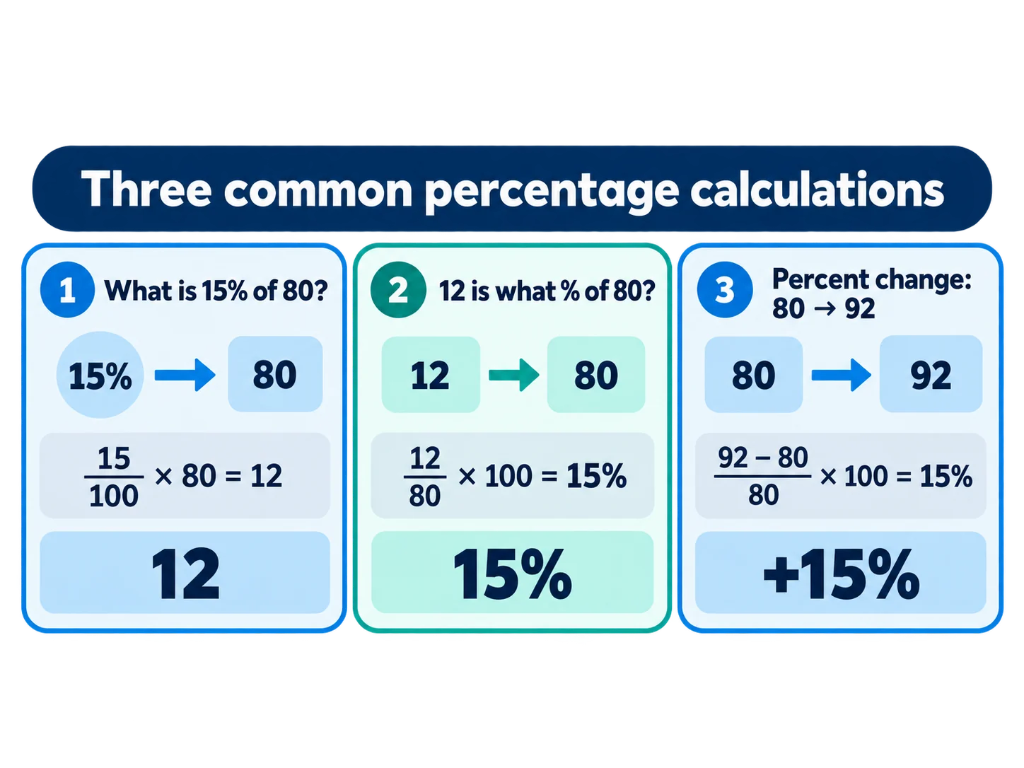
For example, 15% of 80 is 12; 12 out of 80 is 15%; and a rise from 80 to 92 is a 15% increase. Those answers all involve percentages, but they answer different questions. For a calculation involving a marked-down price, use the Discount Calculator; for adding a tax rate to a price, use the Sales Tax Calculator.
Which percentage calculation do you need?
To find a part of a whole, multiply the whole by the percentage expressed as a decimal. To find what proportion one value represents, divide the part by the whole and multiply by 100. To calculate change, subtract the starting value from the ending value, divide by the starting value, and multiply by 100. A negative result in the change mode indicates a decrease. Unlike the first mode, the other two have a denominator: a whole of zero or starting value of zero cannot be used for those calculations.
Percent change versus percentage-point change
Suppose a rate rises from 20% to 25%. That is an increase of 5 percentage points, but the relative percentage change is 25% because (25−20)/20 × 100 = 25%. Use the change mode to calculate the relative change; interpreting the same result as percentage points would be incorrect. The tool doesn't calculate sequential discounts or add tax and tips together.
Worked example
What is 15% of 80? (15/100)×80 = 12. 12 is what percent of 80? (12/80)×100 = 15%. Percent change from 80 to 92: (92−80)/80×100 = 15% increase.
\[ 0.15\times 80=12;\quad \frac{12}{80}\times 100=15\% \]
Frequently asked questions
Why does percent change use the starting value in the denominator?
Percent change measures relative movement from A to B, so the baseline is A. Using B (or an average) answers a different question and will not match this calculator.
Can I reverse a percentage increase?
A 15% increase followed by a 15% decrease does not return to the original: 80→92, then 92×0.85=78.2. Undo increases with division by (1 + p/100), not another equal-percent decrease.
What's the difference between a percentage and percent change?
A percentage is a part of a whole (what is P% of X, or X as a percent of Y). Percent change is how far a value moved from its start: (new − old) / old × 100. This page has a box for each. The How to Calculate Percentage Change tutorial covers only the movement identity.
Can percentage change be negative?
Yes. A fall from 80 to 60 gives (60−80)/80 × 100 = −25%, a 25% decrease.
Sources
Assumptions and limitations
Results depend on which value you treat as the whole or starting amount. The part-as-percent and percentage-change modes require a nonzero denominator. This tool does not apply compound percentage adjustments, discounts, taxes, or tips in sequence. Display rounding may hide small differences.