Geometry
Semicircle Area Calculator
Area and curved-plus-diameter perimeter of a semicircle from radius.
Free to use — no sign-up or login.
r = radius · d = diameter · A = area · P = perimeter
Area
Perimeter
Amortization schedule
| # | Date | Payment | Principal | Extra | Interest | Balance |
|---|---|---|---|---|---|---|
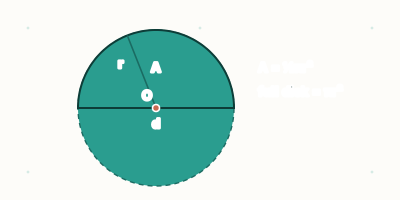
This free semicircle area calculator reports the half-disk and its closed boundary from one radius. Enter r = 4 (the default) and you get area A = ½π(4)² = 8π ≈ 25.13 and perimeter P = π·4 + 2·4 = 4π + 8 ≈ 20.57. The live figure shades that half-disk as A. The curved arc is half the full rim; the diameter along the base is the straight part of the perimeter. Together those two pieces are P — not the arc alone.
No account is required. How it works beside the form keeps A = ½πr² and P = πr + 2r on separate lines. You type Radius r; Area and Perimeter update. This page does not take a typed diameter — if you measured the base, use r = d/2. It does not invert from a known area back to r; the full-disk identities live on the Area of a Circle Calculator.
What is a semicircle?
In strict geometry a semicircle is the 180° arc — half of a circle's rim, with one line of symmetry through the midpoint of that arc. In everyday use the same word means the half-disk: the region bounded by that arc and the diameter that joins its endpoints. You get that cut by slicing a circle through its center, along a diameter. Radius r is the center-to-rim length; diameter d = 2r is the straight base. This calculator treats the half-disk: A is the shaded interior in the figure, and P walks the curved arc then the diameter. An angle inscribed on the arc with endpoints on the diameter is a right angle (Thales' theorem); that is a property of the figure, not an output here.
Area of a semicircle formula
The area of a semicircular disk is half the area of the full circle: A_semi = A_full / 2, or A = ½πr². Square the radius first, then multiply by π/2. With the default r = 4, r² = 16 and A = 8π ≈ 25.13 square units — centimeters of radius give square centimeters of area. That number is not the perimeter; it is the shaded half-disk in the figure. If you already know the full-disk area from the Area of a Circle Calculator, halve it; do not halve the circumference and call that an area.
Perimeter of a semicircle — not half the circumference
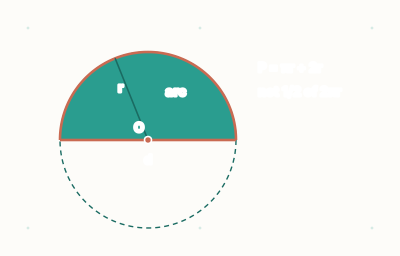
The perimeter is the length of the closed boundary: the curved arc plus the diameter. The arc is half the full circumference, πr, but cutting the circle created a new straight edge of length d = 2r, so P = πr + 2r = r(π + 2), or P = πr + d. At r = 4 the arc is 4π ≈ 12.57 and the diameter is 8, so P ≈ 20.57 length units. Half of the full circumference 2πr = 8π ≈ 25.13 would be only 4π ≈ 12.57 — that is the arc, missing the base. In the figure, A sits in the shaded half-disk; P is the outline, curved part plus straight diameter, not a second name for A. Area uses squared units; perimeter uses length.
How to use this calculator
Type Radius r (default 4). Area is ½πr²; Perimeter is πr + 2r. Both outputs use the same length unit you typed: meters of radius give square meters of area and meters of perimeter. You do not enter diameter, area, or a central angle. If you measured the base instead of the spoke, divide by two first (d = 2r). Full-circle area and circumference from a known r are the Area of a Circle Calculator and the How to Calculate Circle Area and Circumference tutorial. A 180° opening at the center is the Central Angle Calculator.
r = 0, full circle vs half-disk, and hemisphere
Radius r = 0 is rejected: the script throws "r must be positive." A zero radius is a point, not a half-disk with area or perimeter. A negative r is also blocked. The full circle with the same r has area πr² (twice this page's A) and circumference 2πr; at r = 4 that full area is 16π ≈ 50.27. Numerically the half-disk area 8π matches the full circumference 8π at this radius — they still have different units, so they are not interchangeable. A hemisphere is the 3-D half-ball, with curved surface 2πr² and volume ⅔πr³; that is the Sphere Calculator, not a semicircle in the plane.
Related circle formulas
Area πr² and circumference 2πr from a known radius are the Area of a Circle Calculator. Expanding (x − h)² + (y − k)² = r², including the upper-half graph y = k + √(r² − (x − h)²), is the Equation of a Circle Calculator. The 180° central angle that intercepts this arc (s = πr) is the Central Angle Calculator. Sine and cosine as a point on x² + y² = 1 are the Unit Circle Calculator. The same r in three dimensions is the Sphere Calculator.
Worked example: radius 4
Radius r = 4. Diameter is twice that: d = 8. Area of the shaded half-disk is ½πr² = ½π(16) = 8π ≈ 25.13 square units. The curved arc is πr = 4π ≈ 12.57; add the diameter to close the boundary: P = 4π + 8 ≈ 20.57 length units. Those are the Area and Perimeter fields for the defaults. In the figure, A labels the half-disk; P is the outline — arc plus the straight base — not half of 2πr.
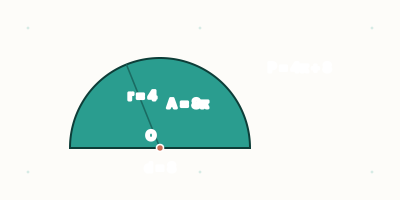
\[ A=\tfrac12\pi\cdot 4^{2}=8\pi,\quad P=4\pi+8 \]
Frequently asked questions
How do I find the area of a semicircle?
Take half the full-disk area: A = ½πr². For r = 4 that is ½π(16) = 8π ≈ 25.13. If you have the diameter instead, use r = d/2 first. This calculator does that from Radius r.
How do I find the perimeter of a semicircle?
Add the curved arc to the diameter: P = πr + 2r, or P = r(π + 2). At r = 4 that is 4π + 8 ≈ 20.57. The arc alone is πr; the extra 2r is the straight base.
Is the perimeter of a semicircle half the circumference?
No. Half the full circumference is the arc πr only. The closed half-disk also includes the diameter, so P = πr + 2r. At r = 4, half of 2πr is 4π ≈ 12.57, while the perimeter is ≈ 20.57.
What happens when the radius is zero?
r = 0 throws "r must be positive." A negative radius is rejected the same way. The figure draws only when r is positive. Geometrically r = 0 is a point, not a half-disk.
What is the difference between a semicircle and a hemisphere?
A semicircle is planar: a 180° arc or the half-disk it bounds. A hemisphere is the 3-D half of a ball. Surface and volume from the same r are the Sphere Calculator, not this page.
Are area and perimeter measured in the same units?
No. Area of the half-disk is in square units (cm²); perimeter is a length (cm). At r = 4, A ≈ 25.13 and P ≈ 20.57 look like similar magnitudes, but one is the shaded region and the other is the outline. Do not paste one result into a field that expects the other.
References
Assumptions and limitations
These semicircle results are unofficial. π is the same constant as JavaScript Math.PI. Length units on the radius carry through: centimeters give area in cm² and perimeter in cm.