Physics
Free Fall Calculator
Distance and impact speed for free fall from rest: s = ½ g t², v = g t.
Free to use — no sign-up or login.
Distance fallen
m
Impact speed
m/s
Amortization schedule
| # | Date | Payment | Principal | Extra | Interest | Balance |
|---|---|---|---|---|---|---|
How far does an object fall in two seconds, and how fast is it moving at that point? This free-fall calculator uses elapsed time and gravitational acceleration to estimate both distance and speed. It models an object released from rest, meaning its starting velocity is zero, and it assumes gravity stays constant during the fall.
Enter time in seconds and gravitational acceleration in meters per second squared. The default gravity of approximately 9.80665 m/s² represents standard Earth gravity, not the exact acceleration at every location. The outputs are distance in meters and speed in meters per second. The calculator does not determine the time needed to fall from a specified height. For a visual walkthrough of how distance grows with time, see How Free Fall Distance Grows.
Why distance increases with time squared
An object released from rest gains speed steadily in the constant-gravity model: after time t, its speed is g times t. But the distance traveled is not speed times total time using that final speed, because the object was moving more slowly earlier. Under constant acceleration from rest, distance equals one half times g times t squared. Doubling the time doubles the final speed but quadruples the distance.
What the ideal free-fall model leaves out
Air drag can materially change a real fall, especially for a light object or one with a large surface area. Wind, orientation, changing gravity and an initial upward or downward throw are also outside this simple model. The calculated speed is the speed at the entered time; calling it an impact speed only makes sense if the object reaches a surface at that exact moment. The calculator does not independently check the height of a landing surface.
Worked example: 2 seconds
At t = 2 s and g = 9.80665 m/s²: distance = 0.5 × 9.80665 × 2² = 19.6133 m; speed = 9.80665 × 2 = 19.6133 m/s. The two numbers happen to match here but represent different physical quantities and units.
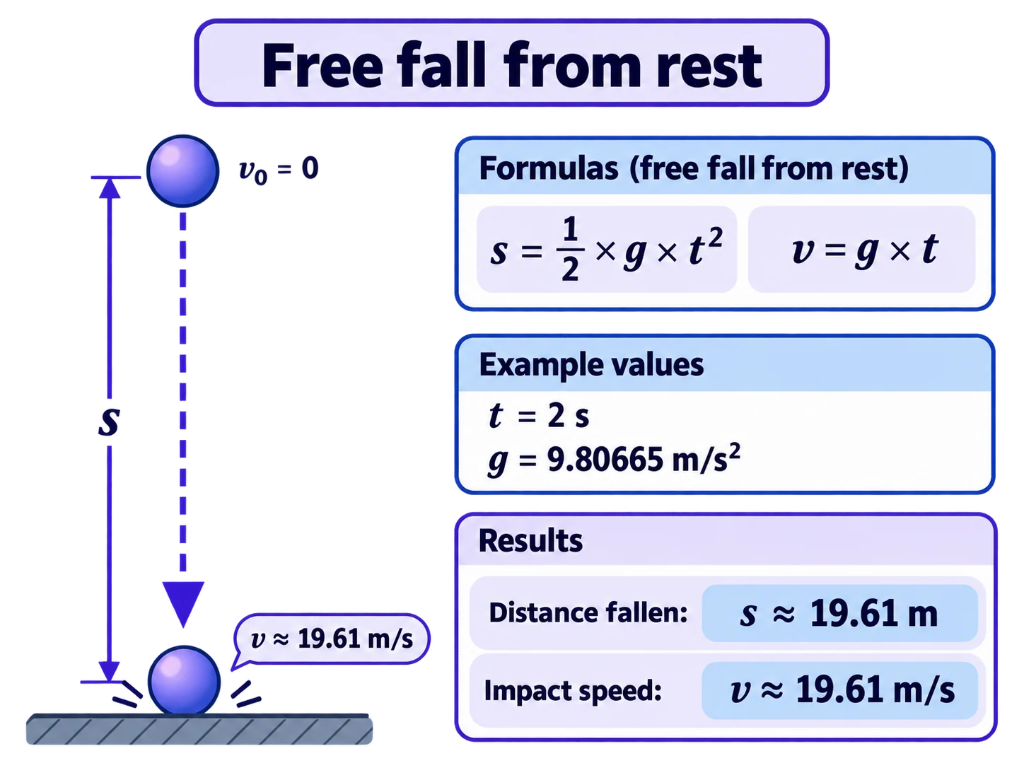
\[ s=\tfrac12(9.80665)(2)^{2}=19.6133,\quad v=(9.80665)(2)=19.6133 \]
Worked example: 4 seconds
At t = 4 s with the same g: distance = 78.4532 m; speed = 39.2266 m/s. Compared with two seconds, the time doubles, the distance quadruples and the speed doubles.
\[ s=\tfrac12(9.80665)(4)^{2}=78.4532,\quad v=(9.80665)(4)=39.2266 \]
Frequently asked questions
Does a heavier object fall faster?
Not in this ideal model. With the same gravitational acceleration and zero initial velocity, mass does not appear in either formula. In air, objects with different shapes and drag can fall differently.
Can I enter a height instead of a fall time?
No. This version calculates distance and speed from time and gravity. It does not directly solve for time using a known height.
Is the calculated speed always the impact speed?
Only if the object reaches the ground or another surface at the time entered. Without a specified fall height, the tool cannot establish when impact occurs.
What units should I use?
Enter time in seconds and gravitational acceleration in m/s². The calculator returns meters and m/s; mixing other units without conversion produces misleading results.
Assumptions and limitations
Assumes constant gravitational acceleration, an object released from rest and negligible air resistance. It does not account for drag, wind, initial velocity, collision height or changes in gravity. It is an educational idealization, not an engineering safety or real-world fall prediction tool.