Physics
Angular Resolution Calculator
Diffraction-limited angular resolution θ ≈ 1.22 λ / D.
Free to use — no sign-up or login.
Visible green is about 550 nm.
Larger D narrows θ. 0.1 m is a 10 cm opening.
λ = wavelength · D = aperture diameter · θ = Rayleigh angle · rings = Airy disks
Angular resolution θ
rad
Angular resolution θ
arcsec
Amortization schedule
| # | Date | Payment | Principal | Extra | Interest | Balance |
|---|---|---|---|---|---|---|
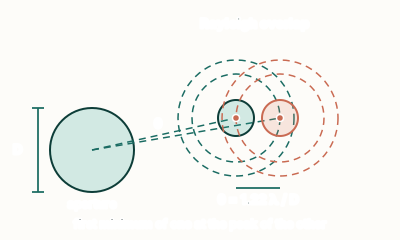
This free Angular Resolution Calculator reports the diffraction-limited Rayleigh angle for a circular aperture. Type the defaults — λ = 550 nm (green visible light) and D = 0.1 m (a 10 cm opening) — and you get θ = 1.22 × 5.5×10⁻⁷ / 0.1 = 6.71×10⁻⁶ rad, which is 1.38″. The live figure is a circular aperture on the left and two Airy disks on the right, labeled λ, D, and θ.
No account is required. How it works beside the form keeps θ = 1.22 λ / D on one line, plus the arcsecond conversion. This page is not the Angular Velocity Calculator (average ω = θ / t). It does not model atmospheric seeing, mirror figure, a central obstruction, or pixel sampling. Treat the number as the ideal diffraction floor, not a guarantee of what a night of observing will show.
What is angular resolution?
Angular resolution is the smallest angle at which two point sources can still be told apart. For a telescope, those sources are usually stars. For a camera or a microscope they are still points in the image, just closer to the instrument. A smaller θ is a finer split: the aperture can separate objects that sit closer together on the sky or on the bench. The calculator does not return a linear size at a distance. It only returns that angle. If you came here looking for how fast an angle changes with time, that is the Angular Velocity Calculator.
The Rayleigh criterion (θ = 1.22 λ / D)
Lord Rayleigh’s working rule for a circular opening is θ = 1.22 λ / D, with λ and D in the same length unit so that θ comes out in radians. Two images are just resolved when the central peak of one Airy disk sits on the first dark ring of the other. That is a convention, not a unique physical cliff: closer than Rayleigh you can still sometimes tell two blobs from one, and farther apart they are obviously two. The snapshot below is that overlap. The identity assumes a uniformly illuminated circular aperture in one wavelength, in the far field, with no aberration. λ from a frequency is a different tool: the Frequency Wavelength Calculator.
Why the factor 1.22?
A uniformly lit circular aperture does not image a point as a point. The far-field pattern is an Airy disk: a bright core and concentric rings. The first dark ring sits where the Bessel function J₁(x) is first zero, at x ≈ 3.8317. Divide that by π and you get about 1.220. Textbooks round it to 1.22. A slit (a one-dimensional opening) uses 1.00 λ / D instead; this page is the circular case. Some observing guides drop the 1.22 and quote λ / D as a rough beamwidth. That is a different rounding, not a different D. This calculator always uses 1.22.
Wavelength and aperture — what improves resolution?
θ shrinks if you shorten λ or enlarge D. Blue light resolves a little tighter than red at the same diameter; radio wavelengths are much longer, so the same dish is a much coarser angle. A 10 cm visible-light aperture at 550 nm is 1.38″; the same 10 cm at 21 cm radio would be hopeless as a telescope. Diameter is the other lever. Doubling D halves θ. Collecting area is a different question — how much light you gather, not how fine the split is — and that area is the Aperture Area Calculator (A = π (D/2)²). A bigger opening helps both ways, but this page only reports the angle.
Radians vs arcseconds
The formula yields radians because λ / D is a length ratio. For small angles, astronomy quotes arcseconds instead: 1 rad = 206265″ (exactly 180×3600/π, rounded). The calculator multiplies by 206265 and also prints the radian value. The defaults 6.71×10⁻⁶ rad × 206265 = 1.38″. A milliarcsecond is 0.001″; a milliradian is a thousand times a microradian, not an arcsecond. If another site reports degrees, divide arcseconds by 3600. The Angular Velocity Calculator uses radians in ω = θ / t and is not a unit converter for this θ.
How to use this calculator
Enter wavelength and pick nm (default), µm, or m. Enter aperture diameter and pick m, cm, or mm. The page converts both to meters, then applies θ = 1.22 λ / D. Read θ in radians and in arcseconds. Visible work is usually nm and cm or m; radio work is often m for both. The live figure updates the labels from the same SI values. Zero or negative λ or D is rejected. There is no second formula mode: this is Rayleigh for a circular aperture, not Dawes, not Sparrow, and not a rectangular slit.
Limitations: seeing, aberrations, and other criteria
A 10 cm aperture at 550 nm is 1.38″. Typical ground-level seeing is often 1–2″, so that telescope is already near the atmospheric floor on many nights; a larger mirror does not buy 1.22 λ / D on the ground unless the seeing is better than the diffraction angle. Space, radio, and adaptive optics are the usual ways around that. A central obstruction, a spider, and figure error all move energy out of the Airy core. Dawes’ visual double-star limit is a slightly tighter empirical rule (about 116 / D(mm) in arcseconds). Sparrow’s criterion is a still closer overlap. None of those are on this form. Pixel scale, Nyquist sampling, and the eye’s own resolution sit downstream of the aperture.
More angular resolution guides
The Rayleigh walkthrough is How to Calculate Angular Resolution with the Rayleigh Criterion. The rest of the jobs around θ = 1.22 λ / D are separate tutorials, not extra modes on this form.
Wavelength at fixed aperture: How Wavelength Affects Telescope Angular Resolution. Aperture at fixed wavelength: How Aperture Diameter Sets Diffraction-Limited Resolution. Radians to arcseconds: How to Convert Angular Resolution from Radians to Arcseconds.
Rayleigh versus Dawes for double stars: How to Compare Rayleigh and Dawes Limits for Double Stars. A camera or lens pupil: How to Estimate the Diffraction Limit of a Camera or Lens. When the atmosphere, not diffraction, wins: How Atmospheric Seeing Limits Real-World Angular Resolution.
Worked example: visible light through a 10 cm aperture
These are the calculator defaults. Wavelength λ = 550 nm = 5.5×10⁻⁷ m, aperture D = 0.1 m. Then θ = 1.22 × 5.5×10⁻⁷ / 0.1 = 6.71×10⁻⁶ rad. In arcseconds, 6.71×10⁻⁶ × 206265 = 1.38″. The same D as 10 cm or 100 mm gives the same SI diameter and the same θ. At this size, 1.38″ is comparable to ordinary seeing, which is why a small visual telescope is often atmosphere-limited, not diffraction-limited. The snapshot below is the live infographic at these inputs: aperture, Airy pair, and θ = 1.38″.
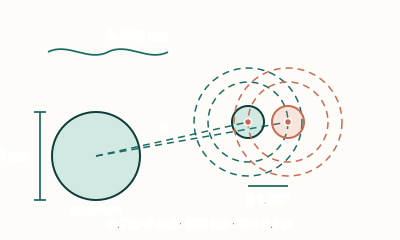
\[ \theta=1.22\,\frac{5.5\times 10^{-7}}{0.1}=6.71\times 10^{-6}\,\mathrm{rad}=1.38^{\prime\prime} \]
Worked example: 21 cm radio through a 25 m dish
Keep the Rayleigh identity, but switch to a long wavelength. Take λ = 0.21 m (the 21 cm hydrogen line) and D = 25 m. Then θ = 1.22 × 0.21 / 25 = 0.010248 rad, which is 2114″, or about 35.2′. That is a coarse beam compared with the 1.38″ visible 10 cm case, even though the dish is 250 times wider: wavelength grew by a much larger factor. Type 0.21 m and 25 m on the form to match the snapshot. Radio work is often diffraction-limited in this sense because seeing is not the same 1–2″ story as at 550 nm. The Frequency Wavelength Calculator turns 1420 MHz into that 0.21 m if you start from frequency.
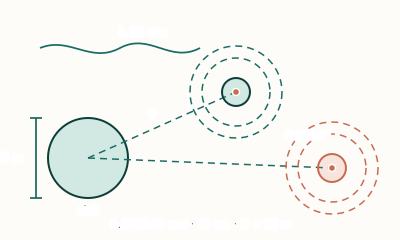
\[ \theta=1.22\,\frac{0.21}{25}=0.010248\,\mathrm{rad}=2114^{\prime\prime} \]
Frequently asked questions
What does this Angular Resolution Calculator actually compute?
It reports the Rayleigh angular resolution of a circular aperture: θ = 1.22 λ / D in radians, and the same angle in arcseconds (×206265). You enter wavelength and diameter with ordinary units; the page converts to meters internally. The number is the diffraction-limited split between two point sources, not a linear size, not a plate scale, and not how fast an angle changes with time.
Why is there a 1.22 in the formula?
The 1.22 is the circular-aperture Airy factor. A point source through a uniform circular opening produces an Airy disk whose first dark ring is at 1.22 λ / D from the peak. Rayleigh’s criterion places the peak of a second source on that ring. A single slit uses 1.00 λ / D; some beamwidth notes drop the 1.22 entirely. This calculator always uses 1.22 for a circular aperture.
What units should I use for wavelength and diameter?
Any pair the form offers, as long as each field’s unit matches the number you typed. Visible light is usually nanometres (550 nm is a green default). Diameter is meters, centimetres, or millimetres — 0.1 m, 10 cm, and 100 mm are the same opening. Radio wavelengths are often meters (0.21 m for 21 cm). Mixing a nanometre wavelength with a meter diameter is expected; the conversion is the point of the unit menus.
Why is the answer in radians and arcseconds?
λ / D is dimensionless, so θ is in radians. Star charts and double-star limits are quoted in arcseconds, so the page also multiplies by 206265. The defaults are 6.71×10⁻⁶ rad and 1.38″. Degrees would be arcseconds divided by 3600. This is still an angle, not angular velocity.
Is this the Angular Velocity Calculator?
No. Angular resolution is a static diffraction angle. Angular velocity is ω = θ / t, how fast an angle changes. The Angular Velocity Calculator is that other tool. A search for “angular” can land on either page; if you have a time in the problem, you want velocity, not Rayleigh.
Does a bigger telescope always show more detail?
Only down to the diffraction floor, and only if the rest of the system is not worse. On the ground, seeing of 1–2″ often dominates a small visible telescope whose Rayleigh angle is already about 1.38″ at 10 cm and 550 nm. A larger D still gathers more light (see the Aperture Area Calculator) and can help if seeing or the instrument is better than θ. Aberrations, a large central obstruction, and undersampled pixels can waste the theoretical split.
How is this different from the Dawes or Sparrow limits?
Rayleigh is the 1.22 λ / D Airy-overlap rule used here. Dawes’ limit is an empirical visual double-star formula, slightly tighter than Rayleigh for the same D. Sparrow’s criterion is a still closer overlap where the combined profile just loses its dip. They differ by tens of percent, not by orders of magnitude. This page does not switch criteria; it is Rayleigh only.
Can I use this for a camera lens or a microscope?
Yes as a diffraction-limit estimate if you treat D as the circular opening (the entrance pupil, not the glass diameter painted on a lens barrel) and λ as the light you actually use. A microscope often cares about the Abbe limit in the sample plane, which is a related but not identical statement. Camera-phone pixels, Bayer filters, and the eye’s own resolution can sit coarser than 1.22 λ / D. Use the number as the aperture’s angle, then check whether the rest of the system is finer or coarser than that.
References
Assumptions and limitations
These angular-resolution values are unofficial teaching estimates for a uniformly illuminated circular aperture in one wavelength. They assume the Rayleigh criterion θ = 1.22 λ / D and ignore atmospheric seeing, aberrations, central obstruction, pixel sampling, and the observer’s eye. The page is not the Angular Velocity Calculator (ω = θ / t) and it is not a prediction of telescope performance on a given night.