Physics · 8 min read
How to Calculate Angular Resolution with the Rayleigh Criterion
θ = 1.22 λ / D for a circular aperture — then convert to arcseconds
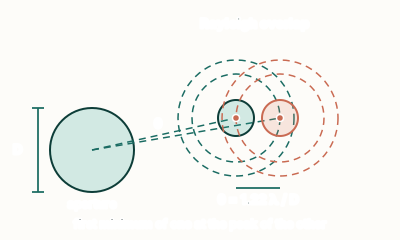
Two point sources are just resolved when the first dark ring of one Airy pattern sits on the peak of the other. For a circular aperture that split is θ = 1.22 λ / D. This tutorial works 550 nm through a 10 cm opening to 6.71×10⁻⁶ rad ≈ 1.38″, the same defaults as the Angular Resolution Calculator.
Written by the My Calculator Stack editorial team. About our methods
θ = 1.22 λ / D is the diffraction-limited Rayleigh angle for a circular pupil in one medium. Seeing, collimation, detector sampling, and a non-circular stop all move the real split. This is not the Angular Velocity Calculator (ω = θ / t).
1.What angular resolution is asking
Angular resolution is the smallest angle at which two point sources still look like two, not one smear. Telescopes, camera lenses, and radio dishes all have a floor set by diffraction when everything else is ideal. The number is an angle, not a linear gap on the sky: at distance r the corresponding separation is about s ≈ r θ with θ in radians.
The name collides with angular velocity. Resolution θ here is a static split. Angular velocity ω = θ / t is how fast an angle changes. If you meant spin rate, open the Angular Velocity Calculator instead of this page.
2.The Rayleigh criterion
For a circular aperture the far-field pattern of a point source is an Airy disk: a bright core and fainter rings. Lord Rayleigh’s teaching rule says two equal sources are just resolved when the central maximum of one lands on the first minimum of the other. That geometry collapses to θ = 1.22 λ / D, with λ and D in the same length unit and θ in radians. The Angular Resolution Calculator is that identity with friendlier units and an arcsecond readout.
\[ \theta = 1.22\,\frac{\lambda}{D} \]
3.Why the factor is 1.22
A rectangular slit of width a has its first minimum at λ / a. A circular pupil is a Bessel problem: the first zero of the J₁ diffraction pattern sits at 1.22 λ / D, where D is the diameter, not the radius. Drop the 1.22 and you are quoting a slit, or a rough “order of λ / D,” not the circular Rayleigh limit this calculator uses.
Dawes’ visual double-star limit is a slightly tighter empirical split, about 116 / D(mm) arcseconds, not 1.22 λ / D. Sparrow’s limit is tighter still. Stay on Rayleigh unless a problem names Dawes — that comparison is How to Compare Rayleigh and Dawes Limits for Double Stars.
\[ \theta_{\mathrm{slit}}\approx\frac{\lambda}{a},\quad \theta_{\mathrm{circ}}=1.22\frac{\lambda}{D} \]
4.Worked example: 550 nm through 10 cm
Take λ = 550 nm = 5.50×10⁻⁷ m and D = 0.10 m (10 cm) — the Angular Resolution Calculator defaults. First put both quantities in meters. Then θ = 1.22 × 5.50×10⁻⁷ / 0.10 = 6.71×10⁻⁷ / 0.10 = 6.71×10⁻⁶ rad.
Astronomy almost never leaves the answer in radians. Multiply by 206265 arcseconds per radian: 6.71×10⁻⁶ × 206265 ≈ 1.38″. That is a small amateur-telescope diffraction floor in visible light, before seeing. The conversion steps live in How to Convert Angular Resolution from Radians to Arcseconds.
\[ \theta=1.22\times\frac{5.50\times 10^{-7}}{0.10}=6.71\times 10^{-6}\,\mathrm{rad}\approx 1.38^{\prime\prime} \]
5.Wavelength and aperture playground
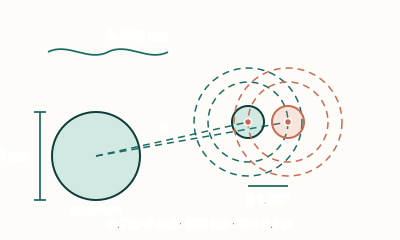
Move λ in nanometres and D in centimetres. The sketch keeps a circular pupil on the left and two Airy cores on the right; their separation tracks θ = 1.22 λ / D. Stretch wavelength or shrink the aperture and the pair spreads. This is a teaching widget, not the full calculator chrome — no unit dropdowns, no favorites. Open the Angular Resolution Calculator when you want metres, millimetres, or a typed radio wavelength. Why λ and D pull in opposite directions is How Wavelength Affects Telescope Angular Resolution and How Aperture Diameter Sets Diffraction-Limited Resolution.
Inline playground
θ (radians)
6.71e-6
θ (arcseconds)
1.38 ″
θ = 1.22 × 550e-9 / 0.10 ≈ 6.71e-6 rad ≈ 1.38″
Teaching sketch only — diffraction-limited ideal, not seeing, collimation, or a camera pixel pitch.
Open the full Angular Resolution Calculator →6.A radio contrast on the same formula
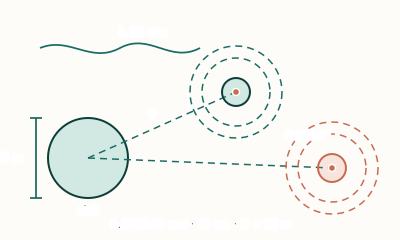
Keep θ = 1.22 λ / D and change only wavelength and dish size. A 25 m radio dish at λ = 21 cm = 0.21 m gives θ = 1.22 × 0.21 / 25 = 0.0102 rad ≈ 2114″ (about 35.2′). That is not a worse telescope in some other sense — it is the same Rayleigh rule at a much longer λ. Frequency and wavelength trade through the Frequency Wavelength Calculator; collecting area of the same circular rim is the Aperture Area Calculator, which does not replace D in the resolution formula.
\[ \theta=1.22\times\frac{0.21}{25}=0.0102\,\mathrm{rad}\approx 2114^{\prime\prime} \]
7.Open the Angular Resolution Calculator
The Angular Resolution Calculator uses θ = 1.22 λ / D, defaults to 550 nm and 0.1 m, and reports radians plus arcseconds. Type 550 nm and 10 cm if you want this worked example in centimetres instead of 0.1 m. It will not apply seeing, Dawes’ limit, or a camera f-number until you convert the pupil yourself. Ground-based blur is How Atmospheric Seeing Limits Real-World Angular Resolution; a photographic stop is How to Estimate the Diffraction Limit of a Camera or Lens.
8.More angular resolution guides
This page is the circular Rayleigh identity with a visible worked example. The same cluster answers the jobs that are easy to mix into the one formula.
Wavelength at fixed D: How Wavelength Affects Telescope Angular Resolution. Aperture at fixed λ: How Aperture Diameter Sets Diffraction-Limited Resolution. Radians to arcseconds: How to Convert Angular Resolution from Radians to Arcseconds.
Rayleigh versus Dawes: How to Compare Rayleigh and Dawes Limits for Double Stars. A lens pupil from f / N: How to Estimate the Diffraction Limit of a Camera or Lens. When the atmosphere wins: How Atmospheric Seeing Limits Real-World Angular Resolution.
Try it yourself
Open the related calculator and put these formulas to work.