Physics · 6 min read
How Aperture Diameter Sets Diffraction-Limited Resolution
At fixed λ, θ scales as 1/D — double the pupil, halve the angle
The Rayleigh angle is θ = 1.22 λ / D. Hold wavelength still and double the aperture, and the diffraction limit halves. This tutorial keeps 550 nm fixed, compares 10 cm with 20 cm, and uses the Angular Resolution Calculator on the same pair.
Written by the My Calculator Stack editorial team. About our methods
A larger D narrows diffraction-limited θ. Collecting area grows as D², which is a different question from the split angle. Ground seeing often caps the gain before the Rayleigh floor.
1.θ is inversely proportional to diameter
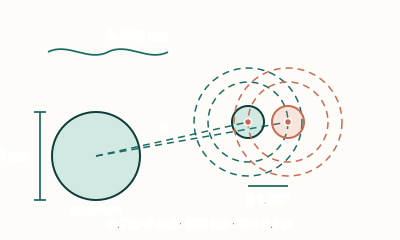
In θ = 1.22 λ / D, wavelength and the 1.22 stay put if you only change the pupil. Then θ ∝ 1/D. A 20 cm scope at 550 nm is twice as sharp, diffraction-wise, as a 10 cm scope at 550 nm. That is not “twice the magnification” and it is not twice the light — those are different jobs. Magnification can empty-enlarge a blur; aperture can shrink the blur’s angular size. The Rayleigh walkthrough is How to Calculate Angular Resolution with the Rayleigh Criterion.
\[ \theta = 1.22\,\frac{\lambda}{D}\quad (\lambda\ \mathrm{fixed}) \]
2.Diameter, not area, enters the angle
Light-gathering power tracks area A = π(D/2)², so four times the area when you double D. Resolution tracks D itself. A fat light-bucket can still be a soft splitter if you only cared about area; a long thin interferometer baseline can split tightly with little area. Compute the circle’s area with the Aperture Area Calculator when the prompt asks for flux or etendue. Keep D, not A, in θ = 1.22 λ / D. Obstruction, spider vanes, and a non-circular stop perturb the Airy pattern; the teaching formula still uses the clear circular diameter you type.
\[ A=\pi(D/2)^{2},\quad \theta=1.22\,\lambda/D \]
3.Worked pair: 10 cm versus 20 cm at 550 nm
λ = 550 nm = 5.50×10⁻⁷ m. For D = 0.10 m, θ = 1.22 × 5.50×10⁻⁷ / 0.10 = 6.71×10⁻⁶ rad ≈ 1.38″ — the calculator default.
Double the aperture to D = 0.20 m and the angle halves: θ = 1.22 × 5.50×10⁻⁷ / 0.20 = 3.355×10⁻⁶ rad ≈ 0.69″. Type 550 nm with 10 cm, then 20 cm, in the Angular Resolution Calculator and read the arcsecond field. Wavelength contrast at fixed D is the other lever: How Wavelength Affects Telescope Angular Resolution.
\[ \lambda=550\,\mathrm{nm}:\quad \theta_{10\,\mathrm{cm}}\approx 1.38^{\prime\prime},\quad \theta_{20\,\mathrm{cm}}\approx 0.69^{\prime\prime} \]

4.When bigger D stops helping
From the ground, atmospheric seeing is often 1–2″. Once your Rayleigh floor drops well below that, extra diameter still collects more photons and can feed adaptive optics, but the raw long-exposure split does not keep halving. An 8-inch (203 mm) at 550 nm is already ≈ 0.68″ — usually seeing-limited outdoors. That ceiling is How Atmospheric Seeing Limits Real-World Angular Resolution. In space, or with a well-corrected AO loop, 1/D keeps paying.
5.More angular resolution guides
The Rayleigh identity: How to Calculate Angular Resolution with the Rayleigh Criterion. Radians to arcseconds: How to Convert Angular Resolution from Radians to Arcseconds. Dawes for double stars: How to Compare Rayleigh and Dawes Limits for Double Stars. A camera f-number pupil: How to Estimate the Diffraction Limit of a Camera or Lens.
Try it yourself
Open the related calculator and put these formulas to work.