Physics · 6 min read
How to Compare Rayleigh and Dawes Limits for Double Stars
1.22 λ / D versus the empirical 116 / D(mm) visual split
Rayleigh’s circular-aperture rule is θ = 1.22 λ / D. Dawes’ limit is a tighter visual recipe for double stars, about 116 / D arcseconds when D is in millimetres. This tutorial compares both at 100 mm and 550 nm using the Angular Resolution Calculator for the Rayleigh number.
Written by the My Calculator Stack editorial team. About our methods
Dawes’ limit is an empirical visual double-star split, not a second diffraction formula. The calculator on this site reports Rayleigh θ = 1.22 λ / D, not Dawes.
1.Two different “just resolved” stories
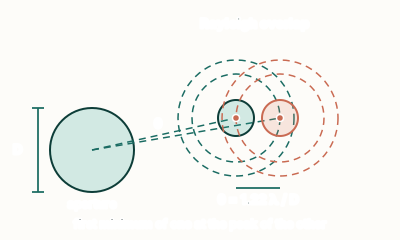
Rayleigh asks when the first dark ring of one Airy disk sits on the peak of the other. That is a defined diffraction geometry, θ = 1.22 λ / D in radians. W. R. Dawes watched close double stars by eye and published a smaller angle that skilled observers could still split on a good night. Dawes is not derived from 1.22; it is a visual performance rule of thumb. The Rayleigh derivation is How to Calculate Angular Resolution with the Rayleigh Criterion.
\[ \theta_{\mathrm{R}}=1.22\,\lambda/D \]
2.Dawes in arcseconds from millimetres
The usual teaching form is θ″_Dawes = 116 / D with D in millimetres, or 4.56 / D with D in inches. Both are already arcseconds; do not multiply by 206265 again. At visual wavelengths the Rayleigh shortcut is about θ″_R ≈ 138 / D(mm) for 550 nm, which is the same 1.22 λ / D after the radian-to-arcsecond conversion in How to Convert Angular Resolution from Radians to Arcseconds. Dawes is then about 84% of Rayleigh at that wavelength: 116/138 ≈ 0.84.
\[ \theta^{\prime\prime}_{\mathrm{Dawes}}=116/D_{\mathrm{mm}}=4.56/D_{\mathrm{in}} \]
3.Worked 100 mm aperture
D = 100 mm = 0.10 m, λ = 550 nm. Rayleigh: θ = 1.22 × 5.50×10⁻⁷ / 0.10 = 6.71×10⁻⁶ rad ≈ 1.38″, or 138 / 100 = 1.38″. Dawes: 116 / 100 = 1.16″. The empirical visual split is 0.22″ tighter than Rayleigh on this aperture.
Type 550 nm and 100 mm (or 0.1 m) into the Angular Resolution Calculator to confirm 1.38″. The form will not print 1.16″ unless you compute 116 / D yourself. Sparrow’s limit is tighter still (roughly λ / D), a photometric “no dip between peaks” criterion, not what this calculator uses.
\[ D=100\,\mathrm{mm}:\quad \theta^{\prime\prime}_{\mathrm{R}}\approx 1.38^{\prime\prime},\quad \theta^{\prime\prime}_{\mathrm{Dawes}}=1.16^{\prime\prime} \]

4.Which number to quote
Homework that says “Rayleigh criterion” wants 1.22 λ / D, then arcseconds if asked. A double-star observing guide that says “Dawes’ limit” wants 116 / D(mm). Do not average them. Seeing of 1.5″ will wash out both 1.38″ and 1.16″ on a 100 mm scope from a typical backyard — How Atmospheric Seeing Limits Real-World Angular Resolution. Growing D still helps on paper: How Aperture Diameter Sets Diffraction-Limited Resolution.
5.More angular resolution guides
The Rayleigh pillar: How to Calculate Angular Resolution with the Rayleigh Criterion. Wavelength at fixed D: How Wavelength Affects Telescope Angular Resolution. A camera pupil: How to Estimate the Diffraction Limit of a Camera or Lens.
Try it yourself
Open the related calculator and put these formulas to work.