Physics · 5 min read
How to Choose Harmonic Order for Street vs Race Intake Stacks
Odd orders 1, 3, 5, 7 — longer for mid-range, shorter for high RPM
Harmonic order O is the lever that turns one target RPM into a family of lengths. This tutorial picks a street-style O = 3 at 6000 rpm versus a shorter race-style O = 5 at 9000 rpm using Ls = (C × 60 × S) / (4 × N × O), the same identity as the Velocity Stack Calculator. The number is a starting length, not a dyno curve.
Written by the My Calculator Stack editorial team. About our methods
Order O is a design choice in a quarter-wave estimate. Cam timing, valve events, and how you actually open the throttle move the real peak. Confirm the length on a dyno. This is not a horsepower prediction.
1.What harmonic order is doing
The intake tract is treated as an open-end quarter-wave tube. Order O = 1 is the first odd harmonic: a long runner and a mid-range bias. O = 3, 5, and 7 are shorter pieces of the same wavelength family. At a fixed RPM, length scales as 1/O, so the fifth harmonic is three fifths of the third, not a different physics. There is no universal street-versus-race O. Street often starts at O = 3 because the tube still fits a chassis; race stacks look stubby because the target RPM is higher and the order is often higher too.
2.The length identity
Ls = (C × 60 × S) / (4 × N × O). C is the speed of sound in the intake air (343 m/s when you type that override). N is the engine speed you care about, not redline for its own sake. S is 2 on a four-stroke and 1 on a two-stroke. Raise O and Ls falls. Raise N and Ls falls. The Velocity Stack Calculator uses this identity and lists orders 1, 3, 5, and 7 in one table so you can compare without retyping.
\[ L_s=\frac{C\times 60\times S}{4 N O} \]
3.Street starting point: O = 3 at 6000 rpm
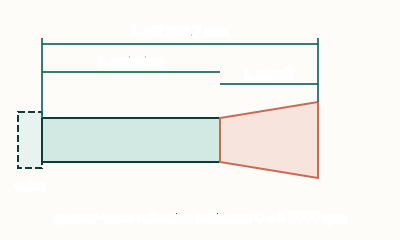
Four-stroke S = 2, C = 343 m/s, N = 6000 rpm, O = 3 — the calculator defaults. Ls = (343 × 60 × 2) / (4 × 6000 × 3) = 0.5717 m = 571.7 mm (22.51 in). Order 1 at the same RPM is 1715 mm, which is a touring-length tube most engine bays will not swallow. Order 5 is 343 mm. If you ride or drive in the middle of the tach, O = 3 is a reasonable first cut. It is still an estimate: a mild cam can want a longer tract than this formula prints.
\[ L_s=\frac{343\times 60\times 2}{4\times 6000\times 3}=0.5717\,\mathrm{m} \]
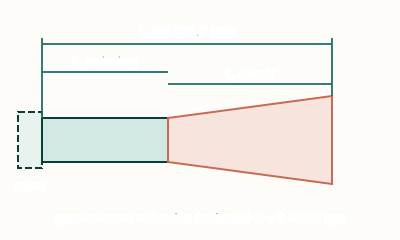
4.Race-style shorter stack: O = 5 at 9000 rpm
Keep four-stroke and 343 m/s, but aim at 9000 rpm on the fifth harmonic. Ls = (343 × 60 × 2) / (4 × 9000 × 5) = 0.2287 m = 228.7 mm (9.00 in). That is not “more power from a short stack.” It is a high-RPM length budget. A peaky race cam with a long O = 1 tract can feel lazy on the street; a short O = 5 stack on a touring engine can feel thin below the power band you sized for. Pick the RPM you actually use, then pick an odd order that fits the space and the band. Verify both on a dyno.
\[ L_s=\frac{343\times 60\times 2}{4\times 9000\times 5}=0.2287\,\mathrm{m} \]
5.Open the calculator table
Put 6000 and O = 3, then 9000 and O = 5, into the Velocity Stack Calculator and read the odd-harmonic table at each RPM. The table is the same identity, not a second model. Subtract the runner you already have before you order a trumpet. This page does not pick a cam, and it does not replace a pull on the rollers.
Try it yourself
Open the related calculator and put these formulas to work.