Physics
Velocity Stack Calculator
Quarter-wave intake length from RPM, stroke, and harmonic order.
Free to use — no sign-up or login.
S = 2 because a four-stroke intakes once every two crank revolutions.
Odd orders 1, 3, 5, 7 are the usual intake harmonics.
Used to estimate C unless you type a manual override.
0 uses C from temperature (~343 m/s at 20 °C). 343 matches the worked examples.
Typical k is about 0.3–0.6 for a flared or flanged mouth.
0 reports the full effective length. Positive values isolate the stack.
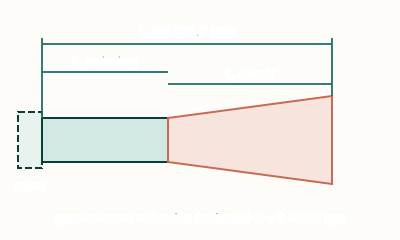
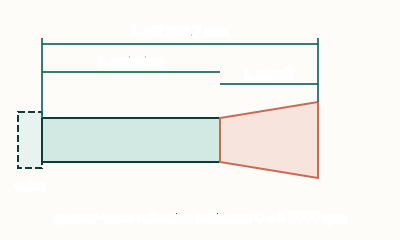
L_existing = valve to stack base · L_stack = trumpet · L_eff = tuned length · D = mouth diameter · dashed = end correction
Result
Effective length
mm
Effective length
in
Stack contribution
mm
Tuned RPM
rpm
Speed of sound
m/s
Odd-harmonic comparison
| Order O | Length (mm) | RPM |
|---|---|---|
Same C and cycle factor. Not a cam, valve, or dyno model.
Amortization schedule
| # | Date | Payment | Principal | Extra | Interest | Balance |
|---|---|---|---|---|---|---|
This free Velocity Stack Calculator estimates the effective intake length that is a quarter-wave of a chosen engine speed and harmonic order. Type the defaults — 6000 rpm, four-stroke (S = 2), order O = 3, and 20 °C air so C ≈ 343 m/s — and you get Ls = (343 × 60 × 2) / (4 × 6000 × 3) = 0.5717 m, which is 571.7 mm or 22.51 in. The live figure is a side-view tract: valve, runner, and flared stack, with L_existing, L_stack, L_eff, and D.
No account is required. How it works beside the form keeps Ls = (C × 60 × S) / (4 × N × O) on one line, plus C from temperature and the optional stack split. This page is not the Velocity Calculator (average v = d/t) and it is not the Velocity Converter. It does not model cam duration, valve events, plenum volume, or ITB flow. Treat the length as a starting estimate and verify it on a dyno.
What is a velocity stack?
A velocity stack is the flared mouth of an intake trumpet. The flare helps the airflow turn into the bore with less separation at the lip; the tube behind the flare is also part of the total length that a pressure wave travels between the intake valve and the open end. Builders use stacks on individual-throttle-body (ITB) banks, motorcycle carburetors and throttle bodies, and some race intakes. The calculator does not care about the brand of the trumpet. It only budgets length. Shape, radius of the lip, and mesh screens are outside this identity. If you came here from a search for average speed, use the Velocity Calculator instead.
How this calculator estimates length
The teaching form is Ls = (C × 60 × S) / (4 × N × O). C is the speed of sound in the intake air. The factor 60 converts revolutions per minute into a per-second wave count. S is 2 on a four-stroke because the intake valve opens once every two crank revolutions, and 1 on a two-stroke. The 4 is the quarter-wave split: an open-end reflection that is a quarter of the acoustic wavelength. O is the harmonic order — 1, 3, 5, 7 for the usual odd intake harmonics. Rearranged, N = (C × 60 × S) / (4 × Ls × O) and C = (Ls × 4 × N × O) / (60 × S). Those two solves are on the form. The formula is an acoustic estimate, not a CFD model of the runner. Wave speed intuition without engines is the Frequency Wavelength Calculator.
Total tract length vs stack length
Ls is the effective acoustic length from the intake valve to the reflecting mouth, not the trumpet sitting on the bench. Measure the existing runner from the valve (or a published port-plus-manifold length) to where the stack will bolt on. Enter that as existing tract length. The page then reports a stack contribution: L_stack ≈ L_eff − L_existing, minus kD if you turned end correction on. If that remainder is negative, the runner you already have is already longer than the tuned length — shorten it, drop to a lower order, or raise target RPM. When existing length is 0, L_stack equals the full effective length (minus any end correction). The live figure labels both pieces so the trumpet is the adjustable end of the tract, not the whole tract.
Choosing a target RPM and harmonic order
A longer tract, or a lower order at the same RPM, moves the estimate toward mid-range. A shorter tract, or a higher odd order, moves it toward high RPM. The defaults use O = 3 at 6000 rpm as a street-style third-harmonic start. The harmonic table lists orders 1, 3, 5, and 7 at the current C and S so you can compare a long first-harmonic tube with a short fifth-harmonic stack without retyping. There is no single correct O for a street motorcycle or a race car; cam timing, valve size, and how wide the throttle is open all shift the real peak. Pick a target you actually use — peak torque, a highway cruise, or a power-band ceiling — then read the table rather than hunting for a magic length.
Speed of sound and intake temperature
Hot intake air raises C and therefore the estimated length at a fixed RPM and order. This page uses C ≈ 331.3 √(1 + T/273.15) with T in °C, so 20 °C gives about 343.21 m/s. A manual C override, when greater than zero, replaces that estimate. Under-hood air is often warmer than the shop, and a long intake tract can be cooler than the manifold. Either way, a 20 °C guess is a starting point, not a lab measurement. Thunder-delay distance with a similar 343 m/s default is the Lightning Distance Calculator; speed relative to local sound speed is the Mach Number Calculator. Those tools are not intake tuners.
End corrections and diameter
An open pipe behaves a little longer than its physical wall length because the reflection sits slightly outside the mouth. A common teaching correction is L_eff = L_phys + kD, with k often in the 0.3–0.6 range for a flanged or flared end and higher for a sharp unflanged pipe. This page leaves the correction off until you choose On, then uses your diameter D and factor k (default 0.3). The stack contribution becomes L_eff − L_existing − kD. Diameter here is only for that optional tick; it does not size the bore for flow. Bulk volume flow in a full circular pipe is the Cylindrical Pipe Flow Rate Calculator — a different question from wave tuning.
How to use the multi-solve modes
Solve for length when you have a target RPM and want Ls and the stack remainder. Solve for RPM when you have already measured a tract (or a stack-plus-runner) and want the engine speed that matches that length at the current S and O. Solve for speed of sound when you want the C that would make a measured length line up with a known RPM — useful as a sanity check, not as a thermometer. Stroke and order stay visible in every mode. Temperature and the C override hide when you are solving for C. End correction and existing length still apply to the length split. Switch modes rather than rearranging the formula on paper; the three solves are the same identity.
More velocity-stack guides
The How-it-works panel opens How to Calculate Velocity Stack Length for a Target RPM. The rest of the jobs around the same identity are separate tutorials, not extra solve modes on this form.
Pick an odd order with How to Choose Harmonic Order for Street vs Race Intake Stacks. Measure valve-to-mouth with How to Measure Total Intake Tract Length Including the Velocity Stack. Warm air changes C in How Intake Air Temperature Changes Your Velocity Stack Estimate.
Flip length and RPM in How to Convert Between Tuned RPM and Velocity Stack Length. Open-end kD is How End Corrections Affect Velocity Stack Sizing. Read 1, 3, 5, and 7 together in How to Compare Odd Harmonics in a Velocity Stack Length Table. ITBs still need a dyno: How to Size Velocity Stacks for ITBs Without Treating Dyno Results as Optional.
Worked example: street 4-stroke mid-RPM
These are the calculator defaults. Four-stroke so S = 2, target N = 6000 rpm, third harmonic O = 3, and C = 343 m/s (20 °C air, or a typed 343). Then Ls = (343 × 60 × 2) / (4 × 6000 × 3) = 41160 / 72000 = 0.5717 m = 571.7 mm = 22.51 in. Order 1 at the same RPM would be three times longer (1715.0 mm); order 5 is 343.0 mm. If the runner from the valve to the stack base is already 350 mm, the stack contribution is 571.7 − 350 = 221.7 mm. The snapshot below is the live infographic at these inputs: valve, runner, flared mouth, and the quarter-wave note at O = 3 and 6000 rpm.
\[ L_s=\frac{343\times 60\times 2}{4\times 6000\times 3}=0.5717\,\mathrm{m}=571.7\,\mathrm{mm} \]
Worked example: high-RPM shorter stack
Keep four-stroke and 343 m/s, but aim at 9000 rpm on the fifth harmonic (O = 5). Then Ls = (343 × 60 × 2) / (4 × 9000 × 5) = 41160 / 180000 = 0.2287 m = 228.7 mm = 9.00 in. That is a much shorter trumpet budget than the 6000 rpm / O = 3 street case. The harmonic table at 9000 rpm still lists the long first-harmonic length if you want to see why race stacks look stubby next to a touring runner. Type 9000 and 5 into the form to match the snapshot. This is still a quarter-wave estimate, not a prediction of peak power at 9000 rpm.
\[ L_s=\frac{343\times 60\times 2}{4\times 9000\times 5}=0.2287\,\mathrm{m}=228.7\,\mathrm{mm} \]
Frequently asked questions
What does a velocity stack calculator tell me?
It estimates the effective intake-tract length that is a quarter-wave of a chosen engine speed and harmonic order. You enter target RPM, two-stroke or four-stroke, order O, and the speed of sound in the intake air (or temperature so the page can derive C). The identity Ls = (C × 60 × S) / (4 × N × O) then reports length in meters, millimeters, and inches, plus a stack remainder if you typed an existing runner. It does not predict horsepower, torque, or a dyno curve. Use the number as a trumpet-plus-runner budget, then confirm the engine on a dyno or with a gas-exchange model.
Is the result the trumpet length or the whole runner?
The raw Ls is the whole effective tract: valve to reflecting mouth. A velocity stack is only the adjustable end of that length. Enter the runner you already have as existing tract length (valve to stack base). The stack contribution is then Ls minus that existing piece, and minus kD if end correction is on. When existing length is zero, the page is telling you the full acoustic budget, which is useful when you are still laying out the manifold. Measure along the centerline of the port and trumpet, not around the outside of a curved runner, if you want the number to mean anything on the engine.
Which harmonic order should I start with?
Odd orders are the usual intake set: 1, 3, 5, 7. Order 1 is a long tract and a low-RPM emphasis; higher odd orders shorten the tube and slide the estimate up the rev range. This page defaults to O = 3 at 6000 rpm as a street-style start, and the harmonic table lists the other odds at the same C and S so you can compare without guessing. Cam duration, valve timing, and how the throttle is used all move the real peak away from a pure quarter-wave, so treat O as a design choice you will verify, not as a part number. There is no universal street-versus-race O that fits every engine.
Does a longer stack make more power?
Not by itself. A longer effective tract, or a lower harmonic at the same RPM, is a mid-range bias in this estimate. A shorter stack or a higher order is a high-RPM bias. Power still depends on how much air the valves, cam, and exhaust let through, and on whether the throttle is actually open in the band you sized for. A long stack on a peaky race cam can feel lazy on the street; a short stack on a touring engine can feel thin in the middle. This calculator does not add horsepower. It only rearranges a quarter-wave length so you have a length to try.
Why does temperature change the length?
The wave travels at the speed of sound in the intake air. Warmer air raises C, and Ls scales with C at fixed RPM, S, and O, so the estimated tract gets longer. This page uses C ≈ 331.3 √(1 + T/273.15) unless you type a manual C. A 20 °C shop guess is about 343 m/s; under-hood air is often hotter, which nudges the length up a few percent. A stack sized in a cold garage can sit slightly off once the bay is hot. Thunder delay with a similar sound-speed default is the Lightning Distance Calculator, which is not an intake tool.
2-stroke vs 4-stroke — what's different here?
Only the cycle factor S. A four-stroke draws on the intake once every two crank revolutions, so S = 2. A two-stroke has an intake event every revolution, so S = 1. That halves the estimated length at the same RPM, C, and order. Example: the 6000 rpm, O = 3, C = 343 m/s case is 571.7 mm on a four-stroke and 285.8 mm on a two-stroke. Reed valves, expansion chambers, and piston-port timing are not in the formula. If your engine is a two-stroke, switch the cycle control rather than inventing a different O to fake the factor of two.
Can I use this for ITBs / motorcycles / cars?
Yes as a length budget, with the same caveats on every layout. ITBs, motorcycle carburetors, and car stacks all have a valve (or throttle) end and an open mouth. Measure the existing tract the same way, pick RPM and order for how you actually ride or drive, and treat Ls as the acoustic target. Plenums, shared airboxes, ram-air ducts, and filter lids add volume and extra reflections that this identity ignores. A single-cylinder dirt bike and a four-ITB motorcycle engine can share a formula and still need different hardware. If the intake is buried in a large plenum, this page is a weaker starting point than a model that includes that volume.
Why doesn't this match my dyno or another website?
Other sites may use a different S convention, a different odd-order default, a Helmholtz resonator instead of a quarter-wave tube, or an end-correction constant they do not print. A dyno sees cam timing, valve discharge, exhaust scavenge, and the real temperature in the runner — none of which appear in Ls = (C × 60 × S) / (4 × N × O). If another calculator reports inches and this page reports millimeters, convert before comparing; the Velocity Converter is for speeds, not lengths. When the numbers disagree, check S, O, C, and whether their length is trumpet-only or valve-to-mouth. Then trust the dyno over a teaching formula.
References
Assumptions and limitations
These velocity-stack lengths are unofficial teaching estimates. They assume a quarter-wave open-end reflection, a constant speed of sound, and a cycle factor S of 2 or 1. The page does not model cam duration, valve events, plenum volume, ITB flow, or a dyno curve. It is not the Velocity Calculator (v = d/t) and it is not a substitute for measurement on the engine.