Finance
Future Value Calculator
Project how a present amount grows at a periodic rate.
Free to use — no sign-up or login.
Future value
Amortization schedule
| # | Date | Payment | Principal | Extra | Interest | Balance |
|---|---|---|---|---|---|---|
Future value answers a specific question: if you leave an amount invested or on deposit and it grows by the same percentage each period, what would it be worth after a chosen number of periods? Enter a present value, the growth rate per period, and how many times growth is applied. The calculator compounds the original amount; it does not assume additional deposits.
Be careful to match the rate to the period. A rate of 5% per year over 10 years is entered as 5 and 10. A rate of 0.5% per month over 24 months is entered as 0.5 and 24. The calculator does not convert an annual interest rate to a monthly one automatically, and it does not predict market returns. For recurring deposits, try the Investment Calculator.
How compounding changes the result
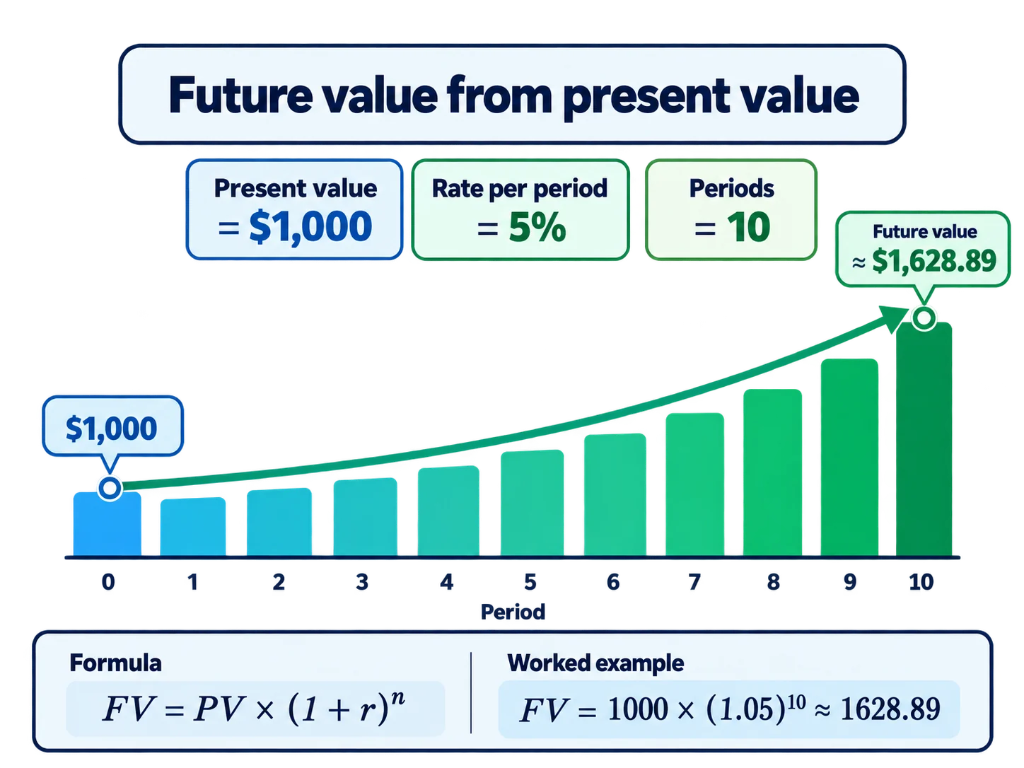
Each period's increase applies to the balance at the start of that period, including any earlier growth. At 5% per period, $1,000 becomes $1,050 after one period and $1,102.50 after two. Applying that same factor ten times gives about $1,628.89. This is different from simple interest, which calculates interest on the original principal without earning interest on past interest.
Match rate and number of periods
The rate and number of periods must describe the same time unit. For example, 0.5% per month compounded over 12 months means twelve multiplications by 1.005. If your stated annual rate has a different compounding convention, work out the appropriate per-period rate first. A 6% nominal annual rate compounded monthly corresponds to 0.5% per month, but a 6% effective annual rate does not: the two conventions produce different results.
Worked example
Present value $1,000, 5% per period, 10 periods: FV = 1000 × (1.05)^10 ≈ $1,628.89.
\[ FV=1000(1.05)^{10}\approx 1628.89 \]
Worked example: monthly compounding
Present value $2,000, rate 0.5% per month, 12 months: FV = 2000 × (1.005)^12 ≈ $2,123.36. This uses a constant monthly rate and no extra contributions.
\[ FV=2000(1.005)^{12}\approx 2123.36 \]
Frequently asked questions
Is the rate annual or per period?
The rate field is per compounding period, matching n. If you have a 6% annual rate with monthly compounding, use 0.5% per period and 12 periods per year (or convert before you enter values).
Does this include extra deposits?
No. This is a single present amount. For recurring deposits, use an investment / annuity-style calculator.
Does future value include inflation?
This tool reports growth in the same nominal currency units as the present amount. It does not subtract inflation or convert the result to today's purchasing power. Use an inflation calculation separately when that distinction matters.
Why is future value different from simple interest?
With compound growth, each period's gain becomes part of the balance used for the next period. Under simple interest, growth is calculated from the original principal rather than the increasing balance.
What happens if the rate is negative?
In a standard compound-growth model, a negative periodic rate represents a reduction each period, provided the factor (1 + rate/100) is within the calculator's supported numeric domain. A loss followed by an equal-percentage gain does not generally restore the original value.
Sources
Assumptions and limitations
Finance results are illustrative. They typically omit taxes, fees, prepayment penalties, and product rules, and they are not investment or lending advice.
This is a fixed-rate mathematical projection, not a forecast or financial recommendation. It assumes a single initial amount, the same rate each period, and no deposits, withdrawals, fees or taxes. Inflation is not deducted. Real investment values can fluctuate between periods or lose value. Results are subject to rounding and input-domain constraints.