Geometry
Surface Area to Volume Ratio Calculator
S/V for a sphere, cube, or rectangular box; reports surface, volume, and the inverse-length ratio.
Free to use — no sign-up or login.
Sphere, cube, or rectangular box. Other solids are separate tools.
Must be positive. Defaults r = 3 give S/V = 3/r = 1.
Must be positive. A cube's S/V is 6/a.
Labels S, V, and S/V. Numbers are not converted.
r = radius · a = cube side · l, w, h = box · S = surface · V = volume · S/V = surface / volume
Surface area
cm²
Volume
cm³
S/V
1/cm
Amortization schedule
| # | Date | Payment | Principal | Extra | Interest | Balance |
|---|---|---|---|---|---|---|
This free Surface Area to Volume Ratio Calculator reports S, V, and the ratio S/V for a sphere, a cube, or a rectangular box. Type the defaults — a sphere with r = 3 cm — and you get S = 4π(3)² = 36π ≈ 113.10 cm², V = (4/3)π(3)³ = 36π ≈ 113.10 cm³, and S/V = 3/r = 1.00 per cm. The live figure draws that solid and labels S, V, and the ratio from the same inputs.
No account is required. How it works beside the form keeps the three surface identities, the three volume identities, and the shortcut ratios 3/r and 6/a on separate lines. This page is not the Volume tool (box volume only) and it is not Surface (box surface only). It does not take a cylinder, cone, or hemisphere, and it does not model pores, fins, or a living cell. Treat the surface area to volume ratio as a closed-solid geometry number, then apply it.
What is surface area to volume ratio?
Surface area S is the outside of a closed solid — every face of a cube, the skin of a sphere. Volume V is the space inside. The surface area to volume ratio, written S/V, is just those two numbers divided. It answers a practical question: how much outside is there per unit of interior? A tea bag has a lot of surface for a little leaf volume; a bowling ball has very little skin for its bulk. The ratio is not dimensionless. S uses length squared and V uses length cubed, so S/V is one over length (cm⁻¹ if you worked in cm). That is why a 1 cm cube (S/V = 6 per cm) and a 1 m cube (S/V = 6 per m = 0.06 per cm) are not the same story. If you only needed V or only S for a box, use Volume or Surface.
How to calculate surface area to volume ratio for a sphere, cube, or box
Compute S, compute V, divide. For a sphere the identities collapse: S = 4πr², V = (4/3)πr³, so S/V = 3/r. You never need 36π / 36π to see that r = 3 gives 1. For a cube, S = 6a² and V = a³, so S/V = 6/a. Side 3 gives 2. For a rectangular box, S = 2(ℓw + ℓh + wh) and V = ℓwh; there is no shorter letter-free shortcut unless two edges are equal. The defaults 3 × 2 × 1 give S = 22 and V = 6, so S/V = 22/6 ≈ 3.67 per length. Keep r, a, or the three edges in one unit; mixing cm with m silently wrecks the ratio. Sphere S and V without the divide live on the Sphere Calculator; cube S, V, and diagonals on the Cube Calculator.
Why surface area to volume ratio drops as an object gets larger
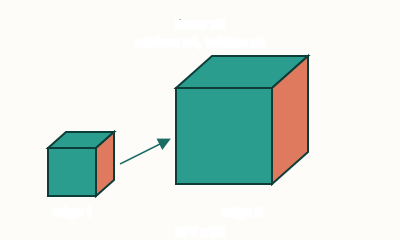
Scale a solid by k and every length multiplies by k. Area goes as k², volume as k³, so S/V goes as 1/k. Double a cube's edge and surface becomes four times, volume eight times, and the ratio halves. The snapshot below is that pair: a unit cube next to a cube twice as wide. The large one looks bulkier because it is — most of the new material is interior, not skin. The same 1/k rule is why 3/r and 6/a shrink when r or a grow. Two solids of the same shape and different size are not interchangeable in a heat or diffusion problem; the smaller copy always has more outside per unit inside. Galileo wrote the square–cube comparison for bones and animals; the algebra on this page is the same comparison for three classroom solids.
Cells, diffusion, and why smaller stays viable
A cell that eats and breathes through its membrane is a surface-limited machine with a volume-limited appetite. Nutrients cross the skin; mitochondria and cytoplasm fill the interior. If you scale a cube-shaped cell from 1 µm to 10 µm, S/V falls from 6 per µm to 0.6 per µm — ten times less membrane per unit of insides, and a longer walk from the centre to the wall. That is the usual classroom reason cells stay small, split, or flatten: they are protecting a high S/V, not chasing a magic micrometre. Real cells are not cubes, and organelles, microvilli, and active transport all cheat the simple ratio. Use this calculator for the geometry of the comparison, not as a metabolism model. A sphere of the same width as a cube always has the lower S/V (3/r versus 6/a with a = 2r), which is why a compact blob is a worse diffuser than a skinny rod of the same volume.
Cooling, heating, and heat leaving through the skin
Heat capacity lives in the volume; heat leaves through the surface. In the lumped teaching model the cooldown time scales with V/S, which is 1/(S/V). A small ice cube reaches the room faster than a large block of the same ice; crushed ice is faster still because you added surface without adding much volume. The same 1/k rule is why a mouse sheds heat more readily than an elephant of similar shape, and why a CPU heat sink is a forest of fins rather than a smooth brick. This page does not solve Newton's law of cooling or name a material. It only hands you S, V, and S/V so you can see which object is the leakier one. Finned hardware, open pipes, and a cylinder's lateral surface are different solids — cylinder S and V without the ratio are the Cylinder Calculator.
Cube versus sphere at the same size
Among closed solids of a given volume, the sphere has the least surface, so it has the lowest S/V. A cube of side 3 has S/V = 2. A sphere of radius 3 has S/V = 1. Those two are not equal-volume twins — the sphere is much larger — but they use the same number 3 in the shortcut, which is how homework problems are often written. Equal volume is the fairer packing test: the default sphere holds about 113.10 cm³, so a cube of that volume has side a = (36π)¹/³ ≈ 4.84 cm and S/V ≈ 1.24 per cm, still above the sphere's 1.00. A 3 × 2 × 1 box is less compact still (about 3.67). If a problem says "same width," set the cube side equal to the sphere's diameter (a = 2r) and compare 6/a with 3/r; then the cube is 6/(2r) = 3/r, the same number — because that pairing matches diameter to edge, not volume to volume.
How to use this calculator
Choose Sphere, Cube, or Box. Enter the positive lengths that appear, then pick mm, cm (default), m, or in. The page does not convert your numbers from one unit to another; it labels S in that unit squared, V in that unit cubed, and S/V as 1 over that unit. Zero or negative edges are rejected. The live figure follows the visible solid: a projected sphere with r, an oblique cube with a, or an oblique box with l, w, h, and the three results on the side. There is no cylinder, cone, capsule, or pyramid mode. For those, compute S and V on the matching geometry page and divide yourself, or stay here with the three solids this form actually owns.
More surface-area-to-volume guides
The walkthrough for S divided by V is How to Calculate Surface Area to Volume Ratio. The rest of the jobs around this page's sphere, cube, and box are separate tutorials, not extra shape modes on this form.
Similar solids and the 1/size drop: How Surface Area to Volume Ratio Changes with Size. Diffusion and why a cell cannot just keep growing: Why Smaller Cells Have a Higher Surface Area to Volume Ratio.
Same linear size, different packing: How to Compare the Surface Area to Volume Ratio of a Cube and a Sphere. Heat leaving through the skin of a solid: How Surface Area to Volume Ratio Affects Cooling and Heating.
Worked example: sphere with r = 3 cm
These are the calculator defaults. Radius r = 3 cm. Surface S = 4πr² = 4π × 9 = 36π ≈ 113.10 cm². Volume V = (4/3)πr³ = (4/3)π × 27 = 36π ≈ 113.10 cm³. The ratio is S/V = 3/r = 3/3 = 1, so S/V = 1.00 per cm. S and V matching numerically is a coincidence of r = 3 (in whatever length unit you chose); the ratio 1 is not a coincidence of π cancelling, it is 3/r. Double the radius to 6 cm and S/V becomes 0.50 per cm — half the outside per unit of inside. The snapshot below is the live infographic at these inputs: sphere, r, S, V, S/V.
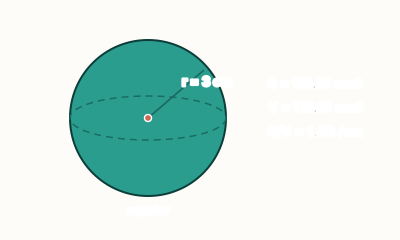
\[ S=4\pi(3)^{2}=36\pi,\quad V=\tfrac{4}{3}\pi(3)^{3}=36\pi,\quad S/V=3/3=1 \]
Worked example: cube with side 3 cm versus that sphere
Switch the shape to Cube and leave the length 3 cm. S = 6a² = 6 × 9 = 54.00 cm². V = a³ = 27.00 cm³. S/V = 6/a = 2.00 per cm. That is twice the default sphere's ratio, but the cube holds less than a quarter of the sphere's volume, so it is not an equal-volume contest. The fair packing check uses the sphere's 113.10 cm³: a cube of that volume has a ≈ 4.84 cm and S/V ≈ 1.24 per cm, still above 1.00. Type 3 on the cube to match the snapshot; type 4.84 if you want the equal-volume pair. The Cube Calculator will confirm 54 and 27 without the ratio.
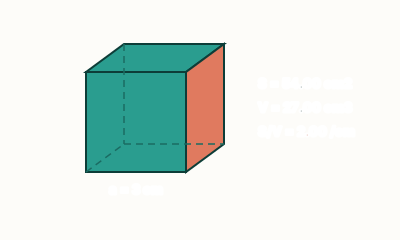
\[ S=6(3)^{2}=54,\quad V=3^{3}=27,\quad S/V=6/3=2 \]
Frequently asked questions
What does this Surface Area to Volume Ratio Calculator compute?
S, V, and the surface area to volume ratio S/V for a sphere, a cube, or a rectangular box. You pick the solid, type positive lengths, and pick a length unit. The defaults (sphere, r = 3 cm) give S ≈ 113.10 cm², V ≈ 113.10 cm³, and S/V = 1.00 per cm. The number is a geometry ratio, not a heat-transfer coefficient and not a cell-biology simulation.
How do I calculate surface area to volume ratio?
Find the surface area, find the volume, divide S by V. For a sphere that is 3/r; for a cube, 6/a; for a box, 2(ℓw + ℓh + wh)/(ℓwh). Use one length unit throughout. The result is 1 over that unit, not a bare number without a length attached.
What units does surface area to volume ratio use?
Inverse length. If edges are in cm, S is cm², V is cm³, and S/V is 1/cm. Millimetres, metres, and inches follow the same pattern. Changing the unit menu relabels the outputs; it does not convert a 3 you already typed into a different 3. A 3 cm sphere and a 3 m sphere are different objects: 1.00 per cm versus 1.00 per m.
Why do smaller objects have a higher surface area to volume ratio?
Because volume grows faster than surface when you scale a shape. Linear size ×k multiplies area by k² and volume by k³, so S/V shrinks as 1/k. A 1 cm cube has S/V = 6 per cm; a 2 cm cube has 3 per cm. Small cells, small ice, and thin wires are leakier per unit of interior for that reason, not because the material changed.
Does a cube or a sphere have the higher surface area to volume ratio?
For equal volume, the sphere is lower — it is the most compact closed solid. A cube of side 3 has S/V = 2; a sphere of radius 3 has S/V = 1, but those volumes differ. Match volumes and the cube still sits higher (about 1.24 versus 1.00 at the default sphere's 113.10 cm³). Match cube side to sphere diameter and the shortcuts 6/a and 3/r give the same number.
Why do smaller things cool (or heat) faster?
Heat is stored with the volume and exchanged at the surface. The cooldown time in a lumped model scales with V/S, the reciprocal of S/V. Smaller similar objects therefore approach the surrounding temperature sooner. This calculator does not apply a heat-transfer coefficient or a material; it only ranks solids by S/V.
Can I use this for a cylinder, cone, or cell shape?
Not as a fourth mode. Cylinder surface and volume are the Cylinder Calculator; cone is the Cone Calculator; a hemisphere is the Hemisphere Calculator. Divide those S and V yourself if you need the ratio. A real cell is not a smooth cube or sphere — use the cube or sphere here as a teaching stand-in, then remember microvilli and organelles change the effective skin.
Is surface area to volume ratio the same as the volume-to-surface ratio?
It is the reciprocal. Some heat-transfer notes quote V/S, a length, because that combination sits in a time constant. This page reports S/V, which is larger for smaller objects. Invert the output if your formula wants V/S. For the default sphere, both happen to be 1.00 in cm and cm⁻¹.
References
Assumptions and limitations
These S/V values are unofficial teaching estimates for a closed sphere, cube, or rectangular box. They assume smooth faces, one length unit, and S/V with no pores, fins, packing voids, or living membrane. The page is not a heat-transfer solver, not a cell simulator, and not the Volume or Surface tools (those skip the ratio). Cylinder, cone, and hemisphere solids are other calculators.