Geometry · 6 min read
How Surface Area to Volume Ratio Affects Cooling and Heating
Heat crosses S; thermal mass sits in V — so the rate tracks S/V
Heat leaves (or enters) through the surface and is stored in the interior. For a similar solid, the cooling rate per degree tracks S/V, which falls as the object grows. This tutorial uses cubes the Surface Area to Volume Ratio Calculator can actually type — 1 cm versus 2 cm — not a cylinder or a person-shaped mesh.
Written by the My Calculator Stack editorial team. About our methods
Newton’s law of cooling is a lumped model: uniform temperature inside, heat transfer proportional to S and to the temperature gap. Real food, engines, and animals have gradients, convection, and radiation. S/V sets the geometric factor, not a complete thermal design.
1.The door is S; the stored heat is V
A hot object loses energy through its skin. The amount of energy stored for a given temperature is roughly proportional to mass, and mass tracks volume if density is the same. Newton’s lumped rule says the temperature gap shrinks at a rate proportional to S/V (times a heat-transfer coefficient you do not type here). A large S/V therefore cools — and heats — faster, all else equal. The geometric ratio is still How to Calculate Surface Area to Volume Ratio.
\[ \frac{dT}{dt}\propto -\frac{S}{V}(T-T_{\infty}) \]
2.Two cubes from the fridge
A 1 cm cube of the same material has S/V = 6 cm⁻¹. A 2 cm cube has S/V = 3 cm⁻¹. The small cube’s specific cooling rate is twice the large one’s, before you argue about air flow. Choose Cube with a = 1, then a = 2, on the Surface Area to Volume Ratio Calculator.
That is why diced potatoes finish before a whole spud, why ice chips vanish while a block sits, and why a thin baking sheet loses heat faster than a Dutch oven of the same metal. Those are kitchen facts sitting on 6/a, not a new formula. A box net without the ratio is Surface; the interior is Volume.
\[ a=1:\ S/V=6;\quad a=2:\ S/V=3 \]
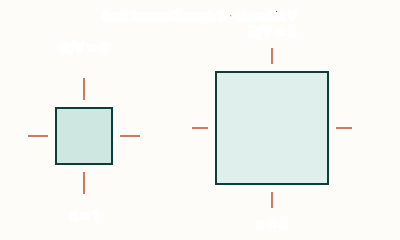
3.Animals, planets, and the same 1/L
A large similar body has a smaller S/V, so it holds heat longer and takes longer to warm through. That is the geometric piece of why shrews lose heat aggressively and why a roast’s centre lags the crust. It is not a proof of every ecological rule named after a 19th-century naturalist — those have caveats — but the 1/L drop is not optional for similar solids. Rocky worlds follow it too: a small asteroid cools through its skin faster than a planet of the same rock. Scaling without the heat story is How Surface Area to Volume Ratio Changes with Size. Cells use the same bottleneck for molecules instead of heat: Why Smaller Cells Have a Higher Surface Area to Volume Ratio.
\[ S/V\propto 1/L \]
4.Shape still matters at one size
Fins, needles, and flattened boxes raise S at nearly fixed V, so they shed heat faster than a cube of the same interior. A sphere of that volume is the slowest of the three calculator solids. Equal-volume cube versus sphere is How to Compare the Surface Area to Volume Ratio of a Cube and a Sphere. The Surface Area to Volume Ratio Calculator will not model convection coefficients; it will tell you whether you just doubled S/V by dicing the same lump.
5.More surface area to volume ratio guides
The identities: How to Calculate Surface Area to Volume Ratio. Scaling: How Surface Area to Volume Ratio Changes with Size. Cells: Why Smaller Cells Have a Higher Surface Area to Volume Ratio. Cube versus sphere: How to Compare the Surface Area to Volume Ratio of a Cube and a Sphere.
Try it yourself
Open the related calculator and put these formulas to work.