Geometry · 7 min read
Why Smaller Cells Have a Higher Surface Area to Volume Ratio
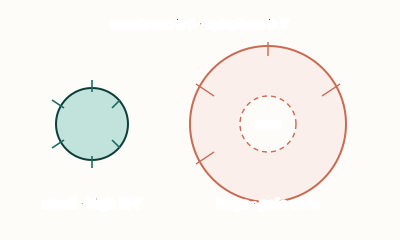
The membrane is S; the cytoplasm is V — S/V falls as the cell grows
A cell swaps food, gases, and waste across its membrane. That membrane is surface; the living interior is volume. As a similar blob grows, S/V falls as 1/L, so each unit of interior gets less gate. This tutorial uses cubes and spheres the Surface Area to Volume Ratio Calculator actually takes, not a cartoon organelle the form cannot draw.
Written by the My Calculator Stack editorial team. About our methods
A cube or sphere is a teaching stand-in for a cell, not a plasma-membrane model. Real cells fold, flatten, and divide. The calculator reports geometry, not a diffusion time or a metabolic rate.
1.The membrane is the only door
Dissolved molecules cross a cell at the surface. The demand for those molecules, and the waste that must leave, scale with how much interior you have to keep alive. If the blob stays the same shape while it grows, S/V drops. At some size the interior is poorly served: the centre is far from the door, and there is not enough door per unit of cytoplasm. That is a geometry bottleneck, not a moral about “small is better” in every other sense. The 1/L scaling is How Surface Area to Volume Ratio Changes with Size.
\[ S/V\propto 1/L \]
2.A 1 cm cube versus a 3 cm cube
Biology labs often soak agar cubes in dye. A 1 cm cube has S/V = 6 cm⁻¹. A 3 cm cube has S/V = 2 cm⁻¹ — one-third the skin per unit of gel. After a few minutes the small cube is stained through; the large one still has a pale core. The dye did not change. The ratio did. Choose Cube with a = 1, then a = 3, on the Surface Area to Volume Ratio Calculator.
A sphere of radius 1 has S/V = 3; r = 3 (the calculator default) has S/V = 1. Same lesson, rounder stand-in. Real cells are closer to tens of micrometres than to centimetres; the algebra does not care. A 10 μm cube would be S/V = 0.6 μm⁻¹. The Cube Calculator still only reports S and V; divide them, or use this S/V page.
\[ a=1\,\mathrm{cm}:\ 6\,\mathrm{cm}^{-1};\quad a=3\,\mathrm{cm}:\ 2\,\mathrm{cm}^{-1} \]
3.Division, flattening, and folds beat raw growth
A cell that doubles as a similar sphere halves S/V. Three common exits: split into two smaller cells (each with a higher S/V), flatten so one length stays small, or wrinkle the membrane (microvilli, cristae) so S grows without a matching V. Those tricks are biology. The calculator will not grow villi. It will tell you that a long thin box has a higher S/V than a cube of the same volume — Box 8 × 1 × 1 versus a cube of side 2. Shape versus size is How to Compare the Surface Area to Volume Ratio of a Cube and a Sphere.
\[ 8\times 1\times 1:\ S/V=4.25;\quad 2^{3}:\ S/V=3 \]
4.This is not a body-surface formula
Human body-surface estimates from height and mass are a different measurement. They are not a sphere whose radius is a person. The Surface Area to Volume Ratio Calculator is three Euclidean solids. Heat leaving an animal is closer to How Surface Area to Volume Ratio Affects Cooling and Heating than to a clinical body-surface formula. The sphere and cube identities are How to Calculate Surface Area to Volume Ratio.
5.More surface area to volume ratio guides
The identities and playground: How to Calculate Surface Area to Volume Ratio. Scaling: How Surface Area to Volume Ratio Changes with Size. Cube versus sphere: How to Compare the Surface Area to Volume Ratio of a Cube and a Sphere. Heat: How Surface Area to Volume Ratio Affects Cooling and Heating.
Try it yourself
Open the related calculator and put these formulas to work.