Geometry · 8 min read
How to Calculate Surface Area to Volume Ratio
S/V for a sphere, cube, or box — then read it as inverse length
Surface-to-volume ratio is the outside divided by the inside: S/V. This tutorial uses the three solids the Surface Area to Volume Ratio Calculator actually takes — sphere, cube, and rectangular box — works the default sphere of radius 3 to S/V = 1, and lets you switch shapes in a playground.
Written by the My Calculator Stack editorial team. About our methods
These identities assume positive lengths in one unit. S/V then has unit inverse length. The calculator on this site is a sphere, cube, or rectangular box (Solid menu). It is not a cylinder, cone, capsule, or body-surface tool.
1.What S/V is asking
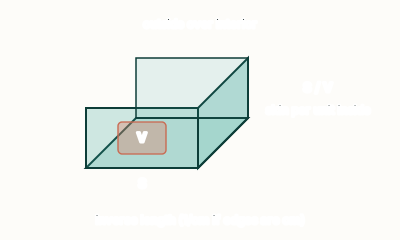
Surface area S is every bit of the outside: six faces of a box, or the entire skin of a sphere. Volume V is how much space sits inside. Divide them and you get how much skin you have per unit of interior. A large S/V means a lot of outside for the amount of stuff inside. A small S/V means a lot of interior hiding behind relatively little skin.
That quotient is not area, and it is not volume. Area is square units; volume is cubes; S/V is inverse length. If every edge is in centimetres, S/V is in cm⁻¹. Mixing inches with centimetres makes the ratio junk until you convert. A box’s interior without the ratio is Volume; a walkthrough of V = ℓwh is How to Calculate Volume of 3D Shapes.
2.The three formulas this calculator uses
The Surface Area to Volume Ratio Calculator takes a Solid (Sphere, Cube, or Box) and then the matching lengths. A sphere uses radius r, S = 4πr², V = (4/3)πr³, so S/V = 3/r. A cube uses side a, S = 6a², V = a³, so S/V = 6/a. A box uses ℓ, w, h, S = 2(ℓw + ℓh + wh), V = ℓwh. There is no cylinder or cone on that form. A cube’s S and V as separate outputs are the Cube Calculator; a sphere’s S and V without the quotient are the Sphere Calculator.
\[ \begin{aligned}(S/V)_{\mathrm{sph}} &= 3/r \\(S/V)_{\mathrm{cube}} &= 6/a \\(S/V)_{\mathrm{box}} &= 2(\ell w+\ell h+wh)/(\ell w h)\end{aligned} \]
3.Worked examples: r = 3, side 3, and a 3×2×1 box
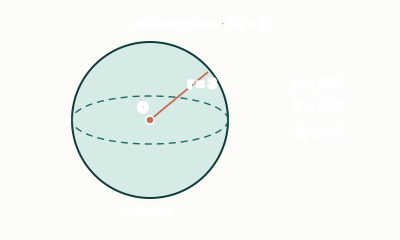
Sphere, r = 3 — the calculator defaults. S = 4π × 9 = 36π ≈ 113.097. V = (4/3)π × 27 = 36π ≈ 113.097. The π cancels and S/V = 3/r = 1. That is exact, not a rounding accident.
Cube, a = 3. S = 6 × 9 = 54. V = 27. S/V = 2. Same characteristic length as the sphere above, different shape, different ratio. A box 3 × 2 × 1: S = 2(6 + 3 + 2) = 22, V = 6, S/V = 11/3 ≈ 3.667. Choose Sphere with r = 3, then Cube with a = 3, then Box with 3 × 2 × 1 on the Surface Area to Volume Ratio Calculator to match all three rows. A box’s six-face area without dividing by V is Surface.
\[ r=3:\ S/V=1;\quad a=3:\ S/V=2;\quad 3\times 2\times 1:\ S/V=11/3 \]
4.S/V playground
Toggle sphere, cube, or box, then move the lengths. The sketch and the three readouts — S, V, and S/V — follow the same identities as the calculator. This is a teaching widget: no favorites, no full chrome. Open the Surface Area to Volume Ratio Calculator when you want the standalone form. Doubling every length does not double the ratio; that scaling story is How Surface Area to Volume Ratio Changes with Size.
Inline playground
Surface S
113.097
Volume V
113.097
S/V
1.000
S/V = 3 / 3 = 1
Teaching aid only — positive lengths in one unit. S/V is inverse length. Extreme ratios may be drawn not to scale.
Open the full Surface Area to Volume Ratio Calculator →5.Open the Surface Area to Volume Ratio Calculator
The Surface Area to Volume Ratio Calculator uses Sphere, Cube, or Box, the same r = 3 default, and reports surface, volume, and the ratio. It will not take a cylinder, a cone, or a body-surface formula. A hemisphere’s S and V without S/V are the Hemisphere Calculator. Which solid exposes more skin at a fixed interior is How to Compare the Surface Area to Volume Ratio of a Cube and a Sphere.
6.More surface area to volume ratio guides
This page is the three identities with the calculator defaults. The same cluster answers the jobs that are easy to fold into one ratio.
How S/V falls as a similar solid grows: How Surface Area to Volume Ratio Changes with Size. Why cells stay small: Why Smaller Cells Have a Higher Surface Area to Volume Ratio.
Cube versus sphere at equal volume: How to Compare the Surface Area to Volume Ratio of a Cube and a Sphere. Cooling and heating: How Surface Area to Volume Ratio Affects Cooling and Heating.
Try it yourself
Open the related calculator and put these formulas to work.