Geometry · 6 min read
How Surface Area to Volume Ratio Changes with Size
Similar solids: S grows as L², V as L³, so S/V falls as 1/L
If you scale a cube or a sphere without changing its shape, surface area grows with the square of the length and volume with the cube. The ratio S/V therefore falls as 1/L. This tutorial doubles a 1-unit cube to side 2 and 4, checks the same 1/r story on a sphere, and uses the Surface Area to Volume Ratio Calculator on those rows.
Written by the My Calculator Stack editorial team. About our methods
S/V ∝ 1/L holds for similar solids — same shape, every length scaled by the same factor. Stretching only one edge of a box is a different story. The calculator does not take cylinders or cones.
1.Squares on the outside, cubes on the inside
Take a cube of side a. Surface is 6a²; volume is a³. Double every edge and each face’s area quadruples, so the whole skin is four times larger, while the interior is eight times larger. The ratio must drop: (4S)/(8V) = (1/2)(S/V). The same counting is the square–cube law. It is not a biology claim yet; it is counting faces versus filling. The three identities themselves are How to Calculate Surface Area to Volume Ratio.
\[ S\propto L^{2},\quad V\propto L^{3},\quad S/V\propto 1/L \]
2.Cube table: side 1, 2, and 4
Side 1: S = 6, V = 1, S/V = 6. Side 2: S = 24, V = 8, S/V = 3. Side 4: S = 96, V = 64, S/V = 1.5. Each doubling of the edge halves the ratio, exactly as 6/a predicts. Choose Cube with a = 1, then 2, then 4 on the Surface Area to Volume Ratio Calculator.
A 1 cm cube is 6 cm⁻¹; a 2 cm cube is 3 cm⁻¹. The unit travels with the length. The Cube Calculator will show S and V growing; this page is the quotient shrinking.
\[ a=1:\ 6;\quad a=2:\ 3;\quad a=4:\ 1.5 \]
3.Spheres follow 3/r, not a different physics
A sphere is S/V = 3/r. Radius 1 gives 3; r = 2 gives 1.5; the calculator default r = 3 gives 1. Double r, half the ratio, same as the cube. Choose Sphere with r = 1, then r = 2, on the Surface Area to Volume Ratio Calculator matches 3 and 1.5. Separate S and V for one radius are the Sphere Calculator. A hemisphere is not a scaled sphere on this form; it is the Hemisphere Calculator.
\[ (S/V)_{\mathrm{sph}}=3/r \]
4.A box is similar only if every edge scales
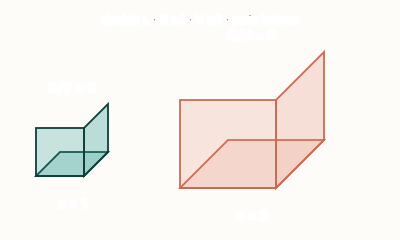
A 3 × 2 × 1 box has S/V = 11/3 ≈ 3.667. Double every edge to 6 × 4 × 2 and S/V halves to 11/6 ≈ 1.833. Stretch only the length to 6 × 2 × 1 and you are no longer similar: S = 2(12 + 6 + 2) = 40, V = 12, S/V = 10/3 ≈ 3.333, which is not half of 3.667. Similarity means one scale factor on every length. Why cells cannot keep growing as similar blobs is Why Smaller Cells Have a Higher Surface Area to Volume Ratio. Heat follows the same 1/L drop: How Surface Area to Volume Ratio Affects Cooling and Heating.
\[ 3\times 2\times 1:\ \tfrac{11}{3};\quad 6\times 4\times 2:\ \tfrac{11}{6} \]
5.More surface area to volume ratio guides
The three identities and the r = 3 default: How to Calculate Surface Area to Volume Ratio. Cube versus sphere at equal volume: How to Compare the Surface Area to Volume Ratio of a Cube and a Sphere. Cells: Why Smaller Cells Have a Higher Surface Area to Volume Ratio. Cooling: How Surface Area to Volume Ratio Affects Cooling and Heating.
Try it yourself
Open the related calculator and put these formulas to work.