Geometry · 6 min read
How to Compare the Surface Area to Volume Ratio of a Cube and a Sphere
Same diameter is a length trick; equal volume is the shape question
A cube has S/V = 6/a and a sphere has S/V = 3/r. Set the cube’s side equal to the sphere’s diameter and both ratios collapse to 6/L — that is a size match, not a shape verdict. Hold volume fixed and the sphere wins (lowest S/V). This tutorial uses Sphere and Cube on the Surface Area to Volume Ratio Calculator, then stretches a box at the same V.
Written by the My Calculator Stack editorial team. About our methods
Among solids of a given volume, a ball has the smallest surface (isoperimetric inequality in 3D). The calculator compares a sphere, a cube, and a box. It does not take a cylinder or a cone.
1.Do not set side = diameter and call it a shape test
Cube: S/V = 6/a. Sphere: S/V = 3/r. If you set a = 2r (side equal to diameter), then 6/a = 6/(2r) = 3/r, so the two ratios match. That is not proof that cubes and spheres are “the same.” You forced the characteristic lengths to line up, so the 1/L factors agreed. The calculator default sphere r = 3 has S/V = 1; a cube of side 6 also has S/V = 1. Same ratio, different interiors (36π versus 216). The identities: How to Calculate Surface Area to Volume Ratio.
\[ a=2r\ \Rightarrow\ 6/a=3/r \]
2.Hold volume at 8, then compare skin
A cube of side 2 has V = 8 and S/V = 3. A sphere of the same volume satisfies (4/3)πr³ = 8, so r = (6/π)^{1/3} ≈ 1.241. Then S/V = 3/r ≈ 2.42. The sphere has less skin per unit of interior. That is the shape comparison. Choose Cube with a = 2, then Sphere with r ≈ 1.241, on the Surface Area to Volume Ratio Calculator.
Among all solids of volume 8, the ball is the tightest wrap. A cube is already less compact; spikes and long slabs are worse. The Sphere Calculator and Cube Calculator will each show S and V; this page is their quotient at matched V.
\[ V=8:\quad (S/V)_{\mathrm{cube}}=3,\quad (S/V)_{\mathrm{sph}}\approx 2.42 \]
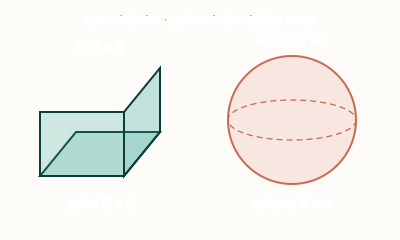
3.A box at the same volume is usually worse than the cube
Keep V = 8 but flatten to 4 × 2 × 1. Then S = 2(8 + 4 + 2) = 28 and S/V = 3.5, above the cube’s 3 and well above the sphere’s 2.42. Box 4 × 2 × 1 on the Surface Area to Volume Ratio Calculator is that row. Cells that need a high ratio flatten or fold; organisms that need to keep heat use rounder, larger bodies. Scaling still applies on top of shape: How Surface Area to Volume Ratio Changes with Size. Membrane vs cytoplasm: Why Smaller Cells Have a Higher Surface Area to Volume Ratio.
\[ 4\times 2\times 1:\ S/V=3.5 \]
4.More surface area to volume ratio guides
How to compute S/V: How to Calculate Surface Area to Volume Ratio. Size: How Surface Area to Volume Ratio Changes with Size. Cells: Why Smaller Cells Have a Higher Surface Area to Volume Ratio. Heat: How Surface Area to Volume Ratio Affects Cooling and Heating.
Try it yourself
Open the related calculator and put these formulas to work.