Geometry · 7 min read
How to Plot the Centroid of a Right Triangle on the Coordinate Plane
Axes, legs b and h, then G = (b/3, h/3) from the right-angle vertex
Homework that says “plot the centroid” wants a point on the plane, not only a formula. Place the right angle at the origin, draw legs b and h along the axes, then mark G = (b/3, h/3) from that vertex — the same average the Centroid of a Triangle Calculator reports from the three vertices.
Written by the My Calculator Stack editorial team. About our methods
G = (b/3, h/3) is measured from the right-angle vertex. Plot it in that frame, or translate if the right angle is not at the origin. This page is plane geometry, not a CAD or graphing-calculator replacement.
1.What you are asked to plot
The centroid G is the average of the three vertices and the point where the medians meet. On a right triangle you can skip hunting midpoints if you put the right angle at the origin: the legs become the axes, and G sits one-third of the way along each leg. From the right-angle vertex, G = (b/3, h/3).
“Plot” means those coordinates on a labeled plane: origin, scales, the two legs, the hypotenuse, and a clear mark at G. A sketch without axes is not a plot. The derivation of the shortcut is in How to Find the Centroid of a Right Triangle at (b/3, h/3).
2.Place the right angle at the origin
Call the right-angle vertex A. Put A at (0, 0), the other end of the horizontal leg at B = (b, 0), and the other end of the vertical leg at C = (0, h). Both b and h must be positive in this drawing; if a leg runs left or down, the corresponding coordinate is negative and G follows that sign. This frame is a choice, not a property of every right triangle on a worksheet. If the given vertices already sit somewhere else, either translate or average the three points — see How to Find the Centroid When the Right Angle Is Not at the Origin.
\[ A=(0,0),\; B=(b,0),\; C=(0,h) \]
3.Compute G before you draw it
Average the vertices, or use the shortcut: Gₓ = (0 + b + 0)/3 = b/3 and Gᵧ = (0 + 0 + h)/3 = h/3. So G = (b/3, h/3), measured from the right-angle vertex. Write that pair with the same units as b and h. Do not plot (b/3, h/3) as if it were already in worksheet coordinates when A is not the origin.
\[ G=\Bigl(\tfrac{b}{3},\tfrac{h}{3}\Bigr) \]
4.Worked plot: b = 6, h = 4
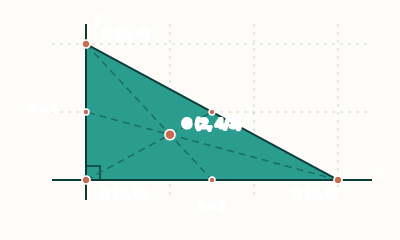
Take legs b = 6 and h = 4, the same pair used across this cluster. Vertices are A(0, 0), B(6, 0), and C(0, 4). Then G = (6/3, 4/3) = (2, 4/3) ≈ (2, 1.33). On paper: draw x and y with the same scale, mark A at the origin with a right-angle square, draw AB along the x-axis to 6, draw AC along the y-axis to 4, connect B to C, then plot G two units right and four-thirds up from A.
G should sit inside the triangle, closer to the right angle than to the hypotenuse — one-third of the way along each leg, not at the midpoint of either. If your mark is at (3, 2), you plotted the midpoint of the hypotenuse (the circumcenter of a right triangle), not the centroid.
\[ G=\Bigl(\tfrac{6}{3},\tfrac{4}{3}\Bigr)=\Bigl(2,\tfrac{4}{3}\Bigr) \]
5.Optional check: sketch one median
If the problem also wants medians, the midpoint of the hypotenuse BC is M = (b/2, h/2) = (3, 2) here. The median from A to M is the segment from (0, 0) to (3, 2). G divides that median 2:1, with the longer piece toward A: (2/3) of (3, 2) is again (2, 4/3). That is a drawing check, not a second definition. The full 2:1 walkthrough is How to Check a Right-Triangle Centroid with Medians (2:1 Ratio). If you only have leg lengths, How to Get Centroid Coordinates of a Right Triangle from Legs b and h turns b and h into the same three vertices.
\[ M=\bigl(\tfrac{b}{2},\tfrac{h}{2}\bigr),\quad G=\tfrac{2}{3}M \]
6.Type the same three vertices into the calculator
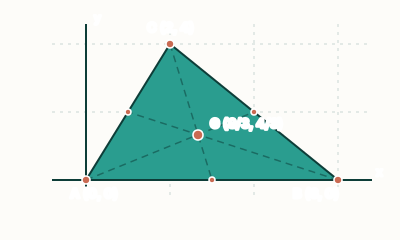
Open the Centroid of a Triangle Calculator and enter A(0, 0), B(6, 0), C(0, 4). The outputs should be G x ≈ 2.00 and G y ≈ 1.33, matching (2, 4/3). The live figure shades the triangle, draws dashed medians, and marks G — the same picture as the snapshot above, with a scale that fits the window.
The calculator’s built-in defaults are A(0, 0), B(6, 0), C(2, 4). That is a scalene triangle, not this right triangle. Leave C at (2, 4) only if you want the general three-vertex tool; change C to (0, 4) to match this plot. Either set still uses G = ((x₁+x₂+x₃)/3, (y₁+y₂+y₃)/3).
7.More right-triangle centroid guides
The shortcut from the right-angle vertex is How to Find the Centroid of a Right Triangle at (b/3, h/3). Why those coordinates are measured from the right-angle vertex: How to Measure the Centroid from the Right-Angle Vertex. If the right angle is already placed off the origin, use How to Find the Centroid When the Right Angle Is Not at the Origin. To verify G on the medians, see How to Check a Right-Triangle Centroid with Medians (2:1 Ratio).
Try it yourself
Open the related calculator and put these formulas to work.