Geometry · 7 min read
How to Find the Centroid of a Right Triangle at (b/3, h/3)
From the right-angle vertex, G sits at one-third of each leg
If a right triangle has its right angle at the origin, the centroid is not a mystery point you have to construct from scratch. From that right-angle vertex, G = (b/3, h/3): one-third of the way along the base and one-third of the way up the height. This tutorial derives that shortcut from the three-vertex average, works b = 6 and h = 4, and opens the same points in the Centroid of a Triangle Calculator.
Written by the My Calculator Stack editorial team. About our methods
G = (b/3, h/3) is measured from the right-angle vertex when that vertex sits at the origin. Move the right angle somewhere else and those two numbers are no longer the absolute coordinates of G. The calculator still averages whatever three vertices you type.
1.What you are looking for
The centroid G is where the three medians meet, and it is also the average of the vertices. For a uniform triangular plate it is the balance point. Homework often asks for the centroid of a right triangle measured from the right-angle vertex. That is a coordinate-frame question, not a different kind of centroid. Park the right angle at (0, 0), let the legs run along the axes, and the average collapses to two easy thirds.
2.Put the right angle at the origin
Call the legs b (along the x-axis) and h (along the y-axis). The vertices are then A = (0, 0) at the right angle, B = (b, 0), and C = (0, h). That is a choice of axes, not a claim that every right triangle in a textbook drawing already lives there. If your sketch has the right angle in a corner of the page, you are allowed to relabel that corner as the origin before you compute. Measuring from the right-angle vertex means those (b/3, h/3) offsets start at A, not at some other corner.
3.Why the average is (b/3, h/3)
Any triangle’s centroid is G = ((x₁+x₂+x₃)/3, (y₁+y₂+y₃)/3). Plug in A, B, and C: the x-coordinates are 0, b, and 0, so Gₓ = (0 + b + 0)/3 = b/3. The y-coordinates are 0, 0, and h, so Gᵧ = (0 + 0 + h)/3 = h/3. From the right-angle vertex, G = (b/3, h/3). You did not need the hypotenuse, an angle, or a median construction — the zero coordinates ate two of the three terms. That is the same identity the Centroid of a Triangle Calculator uses on every triangle, right or not.
\[ G=\left(\frac{b}{3},\frac{h}{3}\right) \]
4.Worked example: legs 6 and 4
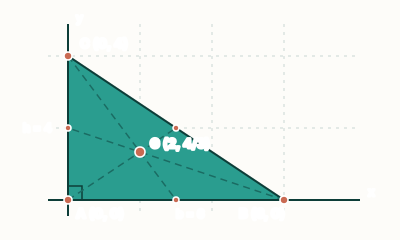
Take b = 6 and h = 4, so the vertices are (0, 0), (6, 0), and (0, 4). Then G = (6/3, 4/3) = (2, 4/3) ≈ (2, 1.33). From the right angle you move 2 units along the base and 4/3 up. The midpoint of the hypotenuse is (3, 2); two-thirds of the way from A toward that midpoint is (2, 4/3), the same G — the 2:1 median check. Type those six numbers into the Centroid of a Triangle Calculator and the live figure should land on the same point.
\[ G=\left(\frac{6}{3},\frac{4}{3}\right)=\left(2,\tfrac{4}{3}\right) \]
5.Legs playground
Move b and h. The sketch keeps the right angle at the origin, draws the medians, and marks G = (b/3, h/3). Under the hood that point is still the average of (0, 0), (b, 0), and (0, h) — the same three-vertex formula. This is a teaching widget, not the full calculator chrome. Open the Centroid of a Triangle Calculator when you want to type arbitrary vertices.
Inline playground
G x = b/3
2.00
G y = h/3
1.33
G = (6/3, 4/3) = (2.00, 1.33)
Teaching aid only — b and h must be positive legs, with the right angle at (0, 0).
Open the full Centroid of a Triangle Calculator →6.The shortcut is the three-vertex formula
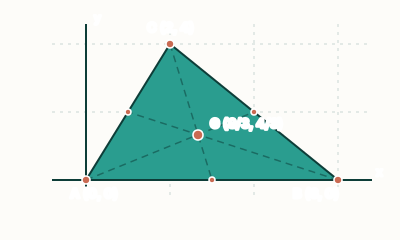
Nothing here is a second centroid. The calculator defaults A(0, 0), B(6, 0), C(2, 4) are not a right triangle at the origin, and G is (8/3, 4/3) because that is the average, not because of b/3. When you do have a right angle at (0, 0), the zeros simply make the average look like (b/3, h/3). If the right angle is not at the origin, do not paste (b/3, h/3) onto the page as absolute coordinates — average the three vertices you actually have, or translate so the right angle sits at the origin first.
7.Open the Centroid of a Triangle Calculator
The Centroid of a Triangle Calculator averages three vertices and draws the medians. For this example type A = (0, 0), B = (6, 0), and C = (0, 4) to match G = (2, 4/3). Leave C at (2, 4) if you want the page defaults instead. The tool does not need to know it is a right triangle. How it works keeps Gₓ and Gᵧ on separate lines plus the 2:1 split along each median.
8.More right-triangle centroid guides
This page is the shortcut with the right angle at the origin. The same cluster answers the jobs that are easy to mix up with it.
Why "from the right-angle vertex" is a frame choice: How to Measure the Centroid from the Right-Angle Vertex. Legs only, no extra coordinates: How to Get Centroid Coordinates of a Right Triangle from Legs b and h. How the shortcut reduces from G = (A+B+C)/3: How the Right-Triangle Centroid Relates to the Three-Vertex Formula.
Axes, medians, and a plotted G: How to Plot the Centroid of a Right Triangle on the Coordinate Plane. When the right angle is not at (0, 0): How to Find the Centroid When the Right Angle Is Not at the Origin. A 2:1 median check of the same G: How to Check a Right-Triangle Centroid with Medians (2:1 Ratio).
Try it yourself
Open the related calculator and put these formulas to work.