Geometry · 6 min read
How the Right-Triangle Centroid Relates to the Three-Vertex Formula
G = (b/3, h/3) is the vertex average after the right angle sits at the origin
The right-triangle shortcut G = (b/3, h/3) is not a second formula. It is the three-vertex average G = ((x₁+x₂+x₃)/3, (y₁+y₂+y₃)/3) after you put the right angle at the origin. This tutorial shows that algebra, why the calculator’s default triangle is not that special case, and when to type the three points instead of dividing the legs by three.
Written by the My Calculator Stack editorial team. About our methods
One formula: the arithmetic mean of the vertices. (b/3, h/3) is that mean in one coordinate frame. Applying it to a triangle whose right angle is not at the origin, or to a triangle that is not right, gives the wrong G.
1.The calculator always averages three vertices
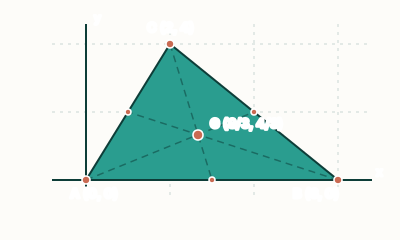
For any triangle in the plane, if A = (x₁, y₁), B = (x₂, y₂), and C = (x₃, y₃), the centroid is G = ((x₁+x₂+x₃)/3, (y₁+y₂+y₃)/3). That is the only identity the Centroid of a Triangle Calculator uses. It does not look at angles, side lengths, or “is this right?” A right triangle is not a different kind of centroid — it is the same average on a nicer set of numbers. The site defaults A(0, 0), B(6, 0), C(2, 4) give G = (8/3, 4/3). That snapshot is a scalene triangle, not the right-triangle shortcut.
\[ G=\left(\frac{x_1+x_2+x_3}{3},\frac{y_1+y_2+y_3}{3}\right) \]
2.Substitute the right-triangle vertices
Place the right angle at the origin: (x₁, y₁) = (0, 0), (x₂, y₂) = (b, 0), (x₃, y₃) = (0, h). Then Gₓ = (0 + b + 0)/3 = b/3 and Gᵧ = (0 + 0 + h)/3 = h/3. The shortcut G = (b/3, h/3) is what is left after two of the three terms in each average are zero. Nothing extra was assumed — no median construction, no area formula. If you need the frame that makes those zeros honest, see How to Measure the Centroid from the Right-Angle Vertex. Building the three points from the legs alone is How to Get Centroid Coordinates of a Right Triangle from Legs b and h.
\[ G=\left(\frac{0+b+0}{3},\frac{0+0+h}{3}\right)=\left(\tfrac{b}{3},\tfrac{h}{3}\right) \]
3.Worked numbers — and the default-triangle trap
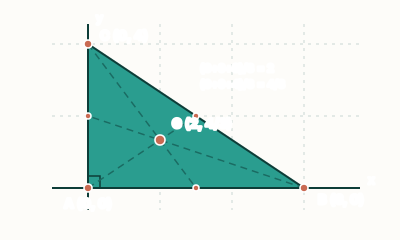
Right triangle with legs 6 and 4: vertices (0, 0), (6, 0), (0, 4). The average is G = (2, 4/3). Same arithmetic as b/3 = 2 and h/3 = 4/3. Type those six numbers into the calculator and the outputs match. The dashed medians still meet at that G; the shortcut did not skip the 2:1 property.
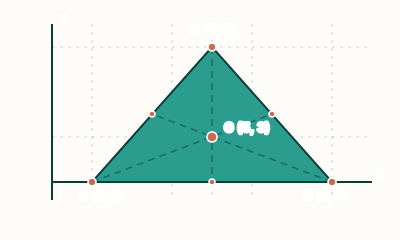
Now the trap. The calculator defaults look similar: A(0, 0), B(6, 0), but C is (2, 4), not (0, 4). If you treat “b = 6, h = 4” and write G = (2, 4/3), you are one vertex off. The real average is ((0+6+2)/3, (0+0+4)/3) = (8/3, 4/3). The y-coordinate happens to match because C still has height 4; the extra 2 in C’s x-coordinate adds 2/3 to Gₓ. An isosceles example on the same page, A(2, 1), B(8, 1), C(5, 7), is even less of a right triangle at the origin: G = (5, 3) from the average, and (b/3, h/3) is not defined until you invent legs that are not the inputs.
\[ \left(\frac{0+6+2}{3},\frac{0+0+4}{3}\right)=\left(\tfrac{8}{3},\tfrac{4}{3}\right)\;\neq\;\left(2,\tfrac{4}{3}\right) \]
4.When to use the shortcut versus the calculator
Use (b/3, h/3) when the problem is a right triangle, you are allowed to put the right angle at the origin, and the legs are the given lengths along the axes. Use the three-vertex average — by hand or on the calculator — when any vertex is already listed, when the right angle is not at (0, 0), when the triangle is not right, or when you would have to guess which side is b. The moved-right-angle case is How to Find the Centroid When the Right Angle Is Not at the Origin. A 2:1 median check of the same G is How to Check a Right-Triangle Centroid with Medians (2:1 Ratio). The isosceles snapshot G = (5, 3) is the average doing its job with no shortcut available. Both routes agree on the right-triangle placement; they disagree only if you apply the shortcut to the wrong three points.
5.Open the three-vertex tool
Enter (0, 0), (6, 0), (0, 4) on the Centroid of a Triangle Calculator to see the shortcut and the average agree, then restore the defaults (0, 0), (6, 0), (2, 4) to see them disagree. That pair of checks is the whole relationship. The placement-first derivation is How to Find the Centroid of a Right Triangle at (b/3, h/3).
6.More right-triangle centroid guides
Measuring the same G from the right-angle vertex: How to Measure the Centroid from the Right-Angle Vertex. Legs b and h with no extra coordinates: How to Get Centroid Coordinates of a Right Triangle from Legs b and h. Plotting the point you just computed: How to Plot the Centroid of a Right Triangle on the Coordinate Plane. A 2:1 median check of the same G: How to Check a Right-Triangle Centroid with Medians (2:1 Ratio).
Try it yourself
Open the related calculator and put these formulas to work.