Geometry · 8 min read
How to Find the Centroid When the Right Angle Is Not at the Origin
Do not treat (b/3, h/3) as absolute coordinates — translate from the right-angle vertex, or average the three vertices
The right-triangle shortcut G = (b/3, h/3) is measured from the right-angle vertex, not from (0, 0) on the worksheet. If that vertex sits at (xᵣ, yᵣ) and the legs run with the axes, add (b/3, h/3) to (xᵣ, yᵣ). The reliable fallback is the three-vertex average on the Centroid of a Triangle Calculator.
Written by the My Calculator Stack editorial team. About our methods
G = (b/3, h/3) is not a pair of absolute plane coordinates unless the right angle is at the origin. If the legs are not parallel to the axes, average the three vertices instead of adding axis components.
1.The shortcut is relative to the right-angle vertex
Place a right triangle with the right angle at the origin and the legs along the axes: vertices (0, 0), (b, 0), (0, h). Then G = (b/3, h/3) from that vertex. That is the same statement as in How to Find the Centroid of a Right Triangle at (b/3, h/3).
“From the right-angle vertex” is a local frame. Sliding the triangle across the plane does not freeze G at (b/3, h/3) in absolute x and y. The centroid rides with the triangle. You either carry the offset of the right-angle vertex, or you forget the shortcut and average the three given points. The same frame choice, without a translated homework triangle, is How to Measure the Centroid from the Right-Angle Vertex.
\[ G_{\text{origin}}=\Bigl(\tfrac{b}{3},\tfrac{h}{3}\Bigr)\quad\text{(right angle at }(0,0)\text{)} \]
2.The common mistake: (b/3, h/3) as absolute coordinates
A typical prompt gives A(3, 1), B(9, 1), C(3, 5). The right angle is at A, the legs are still 6 and 4, so someone writes G = (6/3, 4/3) = (2, 4/3) and plots that pair on the same axes as A, B, and C. That point is the centroid of a copy sitting at the origin. It is not the centroid of the triangle you were given: x = 2 lies left of the whole figure (x runs from 3 to 9).
The mistake is treating a relative offset as a location. (b/3, h/3) answers “how far from the right angle along the legs,” not “what are the worksheet coordinates?” If your G falls outside a clearly interior right triangle, you almost certainly skipped the translation.
\[ (2,\tfrac{4}{3})\neq G\text{ when the right angle is at }(3,1) \]
3.Method 1: translate from the right-angle vertex
Let the right-angle vertex be (xᵣ, yᵣ). If the legs are parallel to the axes, signed lengths b (horizontal) and h (vertical) point along those legs — positive right and up, negative left and down. Then G = (xᵣ + b/3, yᵣ + h/3). You are adding the origin-frame centroid as a vector.
Signs matter. Right angle at (5, 2), other vertices (11, 2) and (5, −2): b = +6 and h = −4, so G = (5 + 2, 2 − 4/3) = (7, 2/3). Dropping the minus and writing (7, 2 + 4/3) puts G above the base instead of below it.
\[ G=\bigl(x_r+\tfrac{b}{3},\; y_r+\tfrac{h}{3}\bigr) \]
4.Worked example: right angle at (3, 1), legs 6 and 4
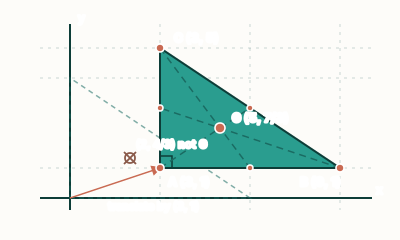
Vertices A(3, 1), B(9, 1), C(3, 5). Horizontal leg b = 9 − 3 = 6, vertical leg h = 5 − 1 = 4, right angle at A = (3, 1). Translate: G = (3 + 6/3, 1 + 4/3) = (3 + 2, 1 + 4/3) = (5, 7/3) ≈ (5, 2.33).
The faint triangle in the figure is the origin copy whose centroid is (2, 4/3) — the pair you would plot if you applied the shortcut as absolute coordinates. The solid triangle is the given one; its centroid is the filled G at (5, 7/3). The coral arrow is the translation (3, 1) from the origin to the actual right angle.
\[ G=\bigl(3+\tfrac{6}{3},\,1+\tfrac{4}{3}\bigr)=\bigl(5,\tfrac{7}{3}\bigr) \]
5.Method 2: average the three vertices
You do not need a special right-triangle formula once the vertices are known. Gₓ = (x₁ + x₂ + x₃)/3 and Gᵧ = (y₁ + y₂ + y₃)/3. For the example: (3 + 9 + 3)/3 = 15/3 = 5 and (1 + 1 + 5)/3 = 7/3. That is the same (5, 7/3). Translation and averaging must agree; if they do not, a sign or a swapped vertex is wrong.
Type A(3, 1), B(9, 1), C(3, 5) into the Centroid of a Triangle Calculator. G x ≈ 5.00 and G y ≈ 2.33. Use this method whenever the vertices are already listed — it does not care which corner is the right angle, and it does not care whether the legs follow the axes. The shortcut is only a convenience when you have been given legs and a right-angle location instead of three points. Why the two formulas are the same identity is How the Right-Triangle Centroid Relates to the Three-Vertex Formula.
\[ G=\left(\frac{3+9+3}{3},\frac{1+1+5}{3}\right)=\left(5,\tfrac{7}{3}\right) \]
6.When the legs are not parallel to the axes
If the right angle is at A but AB and AC are tilted, you cannot add (b/3, h/3) as axis components. Those components assume the legs are horizontal and vertical. Adding them to A walks the wrong direction.
Example: A(1, 1), B(5, 3), C(0, 3). Vectors AB = (4, 2) and AC = (−1, 2) have dot product zero, so the right angle is at A, but neither leg is axis-aligned. The average is G = ((1+5+0)/3, (1+3+3)/3) = (2, 7/3). A + (b/3, h/3) with b = |AB| and h = |AC| is a different point. In this situation skip the shortcut: use the three vertices, by hand or in the calculator.
\[ G=\frac{A+B+C}{3}\quad\text{(any placement)} \]
7.Plot it, then check the other guides
Once you have G in the given coordinates, plot it the same way as How to Plot the Centroid of a Right Triangle on the Coordinate Plane — axes, the actual vertices, then the translated G, not (b/3, h/3) at the origin. To confirm G on a median, see How to Check a Right-Triangle Centroid with Medians (2:1 Ratio). Legs only, with the right angle still to place: How to Get Centroid Coordinates of a Right Triangle from Legs b and h. The three-vertex tool is always the Centroid of a Triangle Calculator.
Try it yourself
Open the related calculator and put these formulas to work.