Geometry
Centroid of a Triangle Calculator
Centroid of a triangle from three vertex coordinates; reports G as the average of the vertices.
Free to use — no sign-up or login.
A, B, C = vertices · G = centroid · dashed = medians
G x
G y
Amortization schedule
| # | Date | Payment | Principal | Extra | Interest | Balance |
|---|---|---|---|---|---|---|
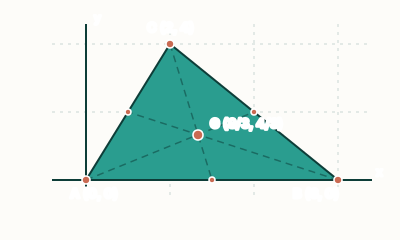
This free centroid of a triangle calculator reports G from three vertices in the plane. Type A = (0, 0), B = (6, 0), and C = (2, 4) — the defaults — and you get G = ((0+6+2)/3, (0+0+4)/3) = (8/3, 4/3) ≈ (2.67, 1.33). The live figure shades triangle ABC, draws the three medians as dashed segments, and marks G at that average.
No account is required. How it works beside the form keeps Gₓ = (x₁+x₂+x₃)/3 and Gᵧ = (y₁+y₂+y₃)/3 on separate lines, plus the 2:1 split along each median. This page is two-dimensional: it does not take a z-coordinate, side lengths, or a mesh. Collinear points still have an average, but they do not form a triangle the figure can shade.
What is the centroid of a triangle?
The centroid G is the point where the three medians meet. A median joins a vertex to the midpoint of the opposite side. G is also the arithmetic mean of the vertices: average the x-coordinates, then the y-coordinates. For a triangular plate of uniform density, that same point is the center of mass — where the triangle would balance. G always lies in the interior of a non-degenerate triangle. It does not jump outside when the triangle is obtuse, which is how it differs from the orthocenter and the circumcenter.
Centroid formula from three vertices
If A = (x₁, y₁), B = (x₂, y₂), and C = (x₃, y₃), the centroid is G = ((x₁+x₂+x₃)/3, (y₁+y₂+y₃)/3). That is the only formula this calculator uses. A right triangle with vertices at (0, 0), (b, 0), and (0, h) is a special case of the same average: G = (b/3, h/3). You do not need angles or side lengths once the vertices are known. The same coordinate-wise mean works in three dimensions if you also average z; this page stays in the xy-plane. Vector form is G = (A + B + C)/3.
Medians and the 2:1 ratio
Each median is the segment from a vertex to the midpoint of the opposite side. The three medians are concurrent at G. Along any one median, G sits two-thirds of the way from the vertex toward the midpoint: the longer piece (vertex to G) is twice the shorter piece (G to midpoint). That is the 2:1 ratio. It follows from G being the average of the vertices: if M is the midpoint of BC, then A − G = 2(G − M). Each median also splits the triangle into two smaller triangles of equal area. The three medians together cut the original triangle into six small triangles of equal area.
Centroid vs orthocenter, circumcenter, and incenter
Four classical triangle centers are easy to mix up. The centroid G is where the medians meet; it is always inside and is the center of mass of a uniform triangular lamina. The orthocenter H is where the altitudes meet: inside an acute triangle, at the right-angle vertex of a right triangle, and outside an obtuse triangle. The circumcenter O is where the perpendicular bisectors meet — the center of the unique circle through A, B, and C — and it leaves the triangle when the triangle is obtuse. The incenter I is where the angle bisectors meet; it is always inside and is the center of the incircle. G, H, and O lie on the Euler line, with HG = 2 GO (they coincide in an equilateral triangle). I is generally not on that line. This calculator finds G only.
How to use this calculator
Enter x and y for vertices A, B, and C. The defaults A(0, 0), B(6, 0), C(2, 4) give G x = 8/3 ≈ 2.67 and G y = 4/3 ≈ 1.33. The figure updates the triangle, the dashed medians, and G. Two vertices the same, or three points on a line, still produce an average in the output fields, but the figure will refuse to shade a zero-area triangle. Area of the same three sides is the Triangle Area Calculator or Heron's Formula Calculator; the length of a side is Distance.
Related triangle formulas
Base-height or three-side area is the Triangle Area Calculator. Three sides through the semiperimeter is Heron's Formula Calculator. A + B + C = 180° for the missing angle is the Triangle Angle Calculator. An equilateral triangle from one side is the Equilateral Triangle Calculator. The straight-line length between two vertices is Distance.
More right-triangle centroid guides
When the right angle sits at the origin, the average of the vertices is G = (b/3, h/3) from that corner — same formula as this page, fewer numbers to type. The walkthrough is How to Find the Centroid of a Right Triangle at (b/3, h/3). The rest of the jobs around that shortcut are separate tutorials, not extra fields on this form.
Why the measurement starts at the right angle: How to Measure the Centroid from the Right-Angle Vertex. Legs b and h only: How to Get Centroid Coordinates of a Right Triangle from Legs b and h. How (b/3, h/3) drops out of averaging three vertices: How the Right-Triangle Centroid Relates to the Three-Vertex Formula.
Sketch axes and medians in How to Plot the Centroid of a Right Triangle on the Coordinate Plane. Check the same G with the 2:1 median split: How to Check a Right-Triangle Centroid with Medians (2:1 Ratio). If the right angle is not at (0, 0), do not treat (b/3, h/3) as absolute coordinates — How to Find the Centroid When the Right Angle Is Not at the Origin.
Worked example: A(0, 0), B(6, 0), C(2, 4)
These are the calculator defaults. Add the x-coordinates: 0 + 6 + 2 = 8, then divide by 3 to get Gₓ = 8/3 ≈ 2.67. Add the y-coordinates: 0 + 0 + 4 = 4, then Gᵧ = 4/3 ≈ 1.33. So G ≈ (2.67, 1.33). The midpoint of AB is (3, 0). Two-thirds of the way from C(2, 4) to (3, 0) is (2, 4) + (2/3)(1, −4) = (8/3, 4/3), the same G — the 2:1 check on that median. The snapshot below is the live infographic at these inputs: triangle ABC, dashed medians, centroid G.
\[ G=\left(\frac{0+6+2}{3},\frac{0+0+4}{3}\right)=\left(\frac{8}{3},\frac{4}{3}\right) \]
Worked example: A(2, 1), B(8, 1), C(5, 7)
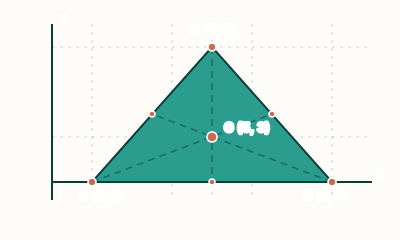
An isosceles triangle sitting on a horizontal base. Average the x-coordinates: (2 + 8 + 5)/3 = 15/3 = 5. Average the y-coordinates: (1 + 1 + 7)/3 = 9/3 = 3. The centroid is exactly G = (5, 3). The midpoint of BC is (6.5, 4). Two-thirds of the way from A(2, 1) toward that midpoint is (2, 1) + (2/3)(4.5, 3) = (5, 3), again G. Type these six numbers into the form to match the snapshot: the apex C is above the base, and G sits on the altitude, two-thirds of the way up from the base toward C. For area of this triangle, the equal sides and base are the Isosceles Triangle Calculator.
\[ G=\left(\frac{2+8+5}{3},\frac{1+1+7}{3}\right)=(5,3) \]
Frequently asked questions
How do I find the centroid of a triangle from three points?
Add the three x-coordinates and divide by 3; add the three y-coordinates and divide by 3. For the defaults A(0, 0), B(6, 0), C(2, 4) that is G = (8/3, 4/3) ≈ (2.67, 1.33). This calculator does that from the six vertex fields.
Why does the centroid divide each median in a 2:1 ratio?
Because G is the average of the vertices. If M is the midpoint of BC, then A − G = 2(G − M), so the segment from the vertex to G is twice the segment from G to the midpoint. The same 2:1 split holds on the other two medians.
Is the centroid the center of mass?
Yes for a triangular plate of uniform density, and also if equal point masses sit at the three vertices. If the mass lives only on the perimeter (a wire triangle), the center of mass is the Spieker center, which is not G in general. A non-uniform plate can have its mass center anywhere inside.
What is the difference between the centroid and the orthocenter?
The centroid is where the medians meet and is always inside the triangle. The orthocenter is where the altitudes meet: inside if the triangle is acute, at the right-angle vertex if it is right, and outside if it is obtuse. They coincide only for an equilateral triangle (along with the circumcenter and incenter).
Does the centroid always lie inside the triangle?
Yes, as long as A, B, and C are not collinear. Acute, right, and obtuse triangles all have G in the interior. The circumcenter and orthocenter are the centers that can leave an obtuse triangle.
Can I find the centroid from side lengths alone?
Side lengths fix the shape, not where you place it in the plane, so they do not give coordinates for G until you choose a position. Once the triangle is drawn you can construct the medians and read G, or assign coordinates and use the average. This page needs the three vertices. Area from three sides is Heron's Formula Calculator.
How do I find the centroid of a triangle in 3D?
Average each coordinate of the three vertices, including z: G = ((x₁+x₂+x₃)/3, (y₁+y₂+y₃)/3, (z₁+z₂+z₃)/3). The geometric meaning is unchanged — medians in the plane of ABC still meet at G. This calculator is 2-D and has no z field. A tetrahedron (four vertices) is a different solid; its centroid averages four points, not three.
What happens if the three points are collinear?
The coordinate average is still defined, so the outputs G x and G y fill in. There is no triangular region and no interior, so the figure will not shade a triangle. Two coincident vertices are the same situation: a segment or a point, not a triangle.
References
Assumptions and limitations
These centroid results are unofficial. They assume three points in the Euclidean plane and the arithmetic mean of the vertices. This page is not a CAD, GIS, or finite-element tool; it does not compute the centroid of a general polygon, a 3-D solid, or a non-uniform plate.