Geometry · 6 min read
How to Get Centroid Coordinates of a Right Triangle from Legs b and h
Two leg lengths become three vertices, then G = (b/3, h/3)
If you only have the two legs of a right triangle, you can still get centroid coordinates. Place the right angle at the origin, turn b and h into the vertices (0, 0), (b, 0), and (0, h), then G = (b/3, h/3). A worked b = 6, h = 4 gives G = (2, 4/3). The hypotenuse is not an input, and the units of the legs become the units of G.
Written by the My Calculator Stack editorial team. About our methods
This placement assumes the right angle is at the origin and the legs lie along the axes. Side lengths alone do not pick a location in the plane until you choose that frame. The hypotenuse is not used.
1.Legs are enough once you choose a placement
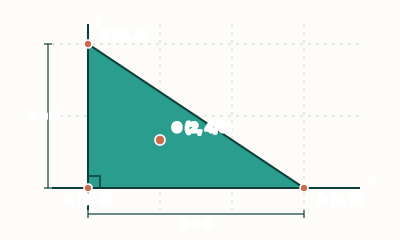
A right triangle is determined up to congruence by its two legs b and h (the sides that meet at the right angle). Coordinates need one more decision: where you put it. The homework convention is to sit the right angle at (0, 0), run b along the x-axis, and run h along the y-axis. After that choice, G has coordinates. Side lengths alone never give a unique (x, y) for G — you could translate or rotate the same triangle — so a problem that asks for coordinates is asking you to adopt this placement unless it already lists vertices. The hypotenuse c = √(b² + h²) is useful for a perimeter or a Pythagorean check; it does not appear in G.
2.Convert the legs into three vertices
Write A = (0, 0), B = (b, 0), and C = (0, h). Those are the only three points you need. If a prompt gives “base 6 and height 4” for a right triangle, it is naming the same two legs: b = 6 along the base, h = 4 as the altitude to that base from the right-angle setup. Do not park the hypotenuse on the x-axis and then treat those two numbers as intercepts — that is a different sketch. Why this origin is the one the shortcut uses is in How to Measure the Centroid from the Right-Angle Vertex.
\[ A=(0,0),\; B=(b,0),\; C=(0,h) \]
3.Average, or jump to (b/3, h/3)
The centroid is the arithmetic mean of the vertices: G = ((0+b+0)/3, (0+0+h)/3) = (b/3, h/3). You can stop at the shortcut once the vertices are in this form. Same result as typing the three points into the Centroid of a Triangle Calculator. The derivation of that collapse, and when you should not skip the average, is How the Right-Triangle Centroid Relates to the Three-Vertex Formula. The pillar walkthrough of this placement is How to Find the Centroid of a Right Triangle at (b/3, h/3).
\[ G=\left(\tfrac{b}{3},\tfrac{h}{3}\right) \]
4.Worked example: b = 6, h = 4
Vertices: (0, 0), (6, 0), (0, 4). Then Gₓ = (0+6+0)/3 = 2 and Gᵧ = (0+0+4)/3 = 4/3, so G = (2, 4/3) ≈ (2.00, 1.33). If the legs are 6 m and 4 m, G is at (2 m, 4/3 m) from the right angle; if they are 6 in and 4 in, the coordinates are in inches. Mixing units (one leg in cm, one in inches) makes G meaningless until you convert. Scaling both legs by k scales G by k: legs 12 and 8 send G to (4, 8/3). A 3-4-5 triangle with legs 3 and 4 is the same recipe at a smaller size: G = (1, 4/3). None of these needs the hypotenuse 5, 10, or √52.
\[ G=\left(\frac{0+6+0}{3},\frac{0+0+4}{3}\right)=\left(2,\tfrac{4}{3}\right) \]
5.Type the three vertices on the calculator
Open the Centroid of a Triangle Calculator and enter x₁ = 0, y₁ = 0, x₂ = 6, y₂ = 0, x₃ = 0, y₃ = 4. The outputs should match G x = 2.00 and G y = 1.33 (4/3). The site defaults are A(0, 0), B(6, 0), C(2, 4) — that C is not (0, 4), so those defaults are not this right triangle. If you leave C at (2, 4) you will not get (2, 4/3). Use the calculator when a later problem hands you three messy vertices instead of two legs; use (b/3, h/3) when the prompt really did give only b and h and the right angle is yours to place at the origin. To mark G on axes after you have the pair, see How to Plot the Centroid of a Right Triangle on the Coordinate Plane.
6.More right-triangle centroid guides
Why those coordinates are measured from the right-angle vertex: How to Measure the Centroid from the Right-Angle Vertex. The placement-first derivation: How to Find the Centroid of a Right Triangle at (b/3, h/3). When the average and the shortcut are the same identity: How the Right-Triangle Centroid Relates to the Three-Vertex Formula. If the right angle is already off the origin: How to Find the Centroid When the Right Angle Is Not at the Origin. A 2:1 median check: How to Check a Right-Triangle Centroid with Medians (2:1 Ratio).
Try it yourself
Open the related calculator and put these formulas to work.