Geometry · 6 min read
How to Measure the Centroid from the Right-Angle Vertex
G = (b/3, h/3) is an offset from the right angle, not a screen coordinate
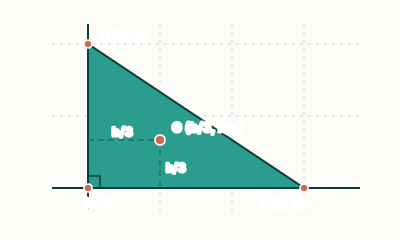
Homework often says the centroid is (b/3, h/3) measured from the right-angle vertex. That phrase names a local frame: put the right angle at the origin, then G sits b/3 along one leg’s direction and h/3 along the other. This tutorial walks that measurement, a b = 6, h = 4 example, and why sliding the triangle changes the absolute coordinates even though the offsets from the right angle stay the same.
Written by the My Calculator Stack editorial team. About our methods
G = (b/3, h/3) is measured from the right-angle vertex after you place that vertex at the origin with the legs along the axes. It is not an absolute pixel or graph-paper coordinate if the right angle sits somewhere else.
1.What “measured from the right-angle vertex” means
The phrase is telling you where to put your zero, not which formula to invent. The right-angle vertex is the origin of the measurement. From that corner you travel a third of the first leg along that leg’s direction, and a third of the second leg along the other. Those two offsets are the coordinates of G in that local frame. They are not measured from the midpoint of the hypotenuse, from a graph-paper corner that is not the right angle, or “up from the base” unless the base is one of the legs starting at the right angle. If a worksheet draws the right angle in the upper left, your origin is still that corner — you just have to notice which way the positive axes run.
2.Put the right angle at the origin
Call the right-angle vertex A. Place A at (0, 0), one leg along the positive x-axis of length b, and the other along the positive y-axis of length h. The three vertices are then (0, 0), (b, 0), and (0, h). That placement is a choice of coordinates, not a claim that the triangle “lives” in the first quadrant of some problem’s printed axes. How to Find the Centroid of a Right Triangle at (b/3, h/3) derives why this frame makes the shortcut honest. If the legs are not axis-aligned on the page, either rotate your sketch until they are, or skip the shortcut and average the three vertices you actually have.
3.Read G as offsets from A
In that frame the centroid is G = (b/3, h/3), measured from the right-angle vertex. The x-coordinate is one-third of the horizontal leg; the y-coordinate is one-third of the vertical leg. G sits inside the triangle, not on a leg: the pair (b/3, h/3) is a point in the plane, not a tick you mark on AB or AC. Drop perpendiculars from G to both legs and you should see those third-of-a-leg distances. The same point is the average of the three vertices and the 2:1 point on each median — the shortcut is only a convenient read of that average once A is at the origin.
\[ G=\left(\tfrac{b}{3},\tfrac{h}{3}\right) \]
4.Worked example: b = 6, h = 4 from A
Take legs b = 6 and h = 4 with the right angle at A(0, 0). Then G = (6/3, 4/3) = (2, 4/3) ≈ (2, 1.33), measured from A. Walk two units along the base from A and 4/3 units up from A; that interior point is G. If the legs are in centimeters, G is 2 cm across and 4/3 cm up from the right angle — the units travel with the legs. The hypotenuse length √(6²+4²) never enters the coordinates. For turning those two lengths into vertices without talking about frames, see How to Get Centroid Coordinates of a Right Triangle from Legs b and h.
\[ G=\left(\tfrac{6}{3},\tfrac{4}{3}\right)=\left(2,\tfrac{4}{3}\right) \]
5.Slide the triangle and the absolute numbers change
Keep the same legs, but put the right angle at (2, 1) instead of the origin, still axis-aligned. The vertices become (2, 1), (8, 1), and (2, 5). The average is G = ((2+8+2)/3, (1+1+5)/3) = (4, 7/3). That is not (2, 4/3). Subtract the right-angle vertex and you recover the offsets: (4−2, 7/3−1) = (2, 4/3) = (b/3, h/3). The shortcut still describes the location relative to the right angle; it does not print the graph-paper coordinates unless that vertex is at (0, 0). The full translate-or-average treatment is How to Find the Centroid When the Right Angle Is Not at the Origin.
\[ (4,7/3)-(2,1)=\left(2,\tfrac{4}{3}\right) \]
6.Check the offsets on the calculator
Type A = (0, 0), B = (6, 0), C = (0, 4) into the Centroid of a Triangle Calculator and read G = (2, 4/3). Then change A to (2, 1) and shift B and C with it: the outputs jump to (4, 7/3), which is the same (b/3, h/3) offset from the new right angle. The live figure is the three-vertex average, not a second model. Marking that point on axes is How to Plot the Centroid of a Right Triangle on the Coordinate Plane.
7.More right-triangle centroid guides
The derivation with the right angle at the origin is How to Find the Centroid of a Right Triangle at (b/3, h/3). Two legs and no extra coordinates: How to Get Centroid Coordinates of a Right Triangle from Legs b and h. Why the shortcut is the same average: How the Right-Triangle Centroid Relates to the Three-Vertex Formula. A 2:1 median check of the same G: How to Check a Right-Triangle Centroid with Medians (2:1 Ratio).
Try it yourself
Open the related calculator and put these formulas to work.